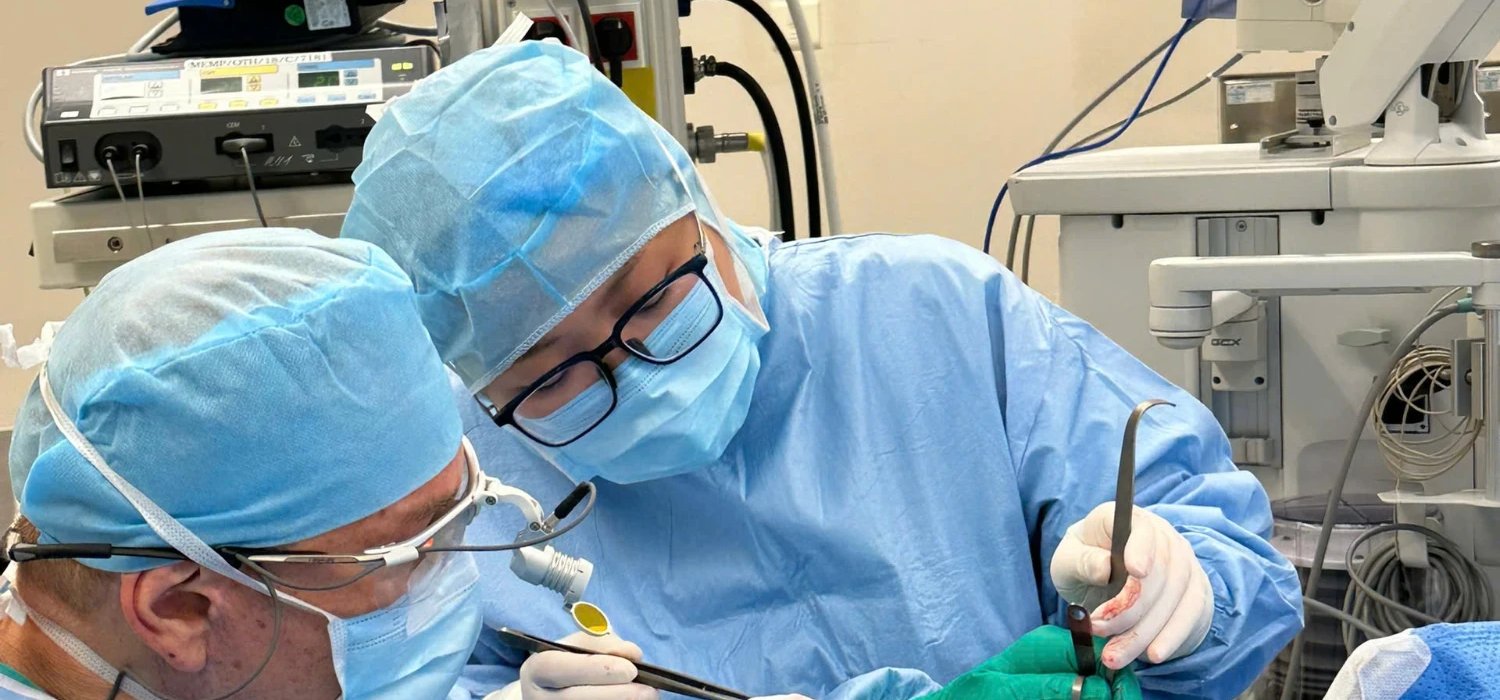
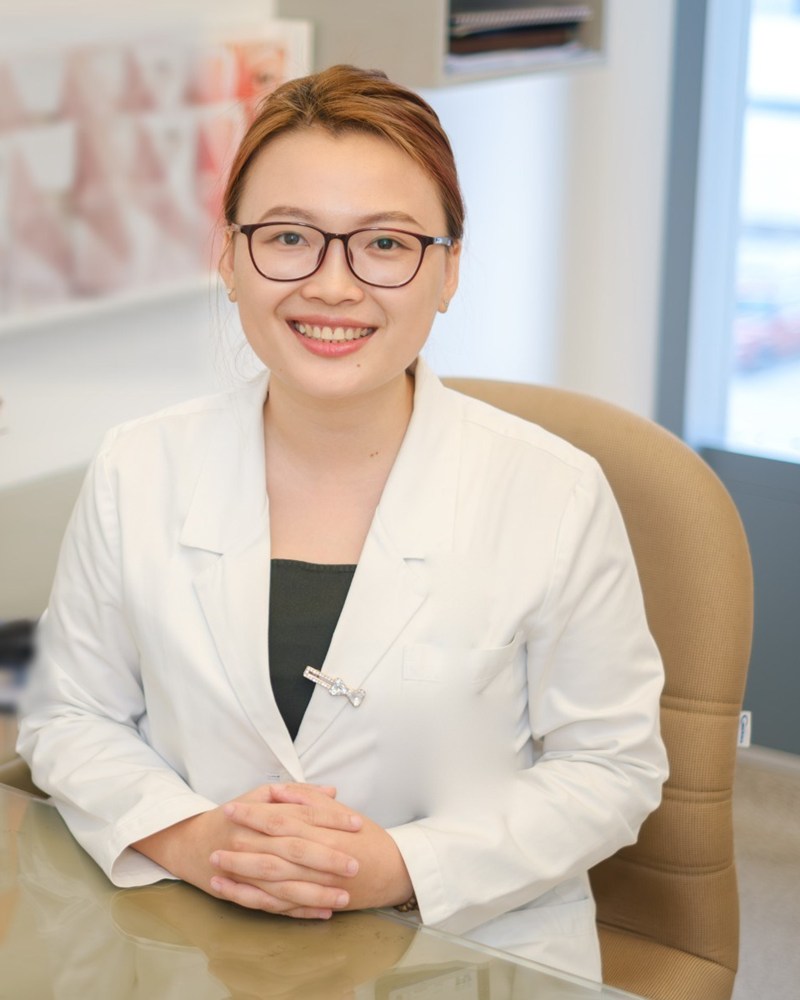
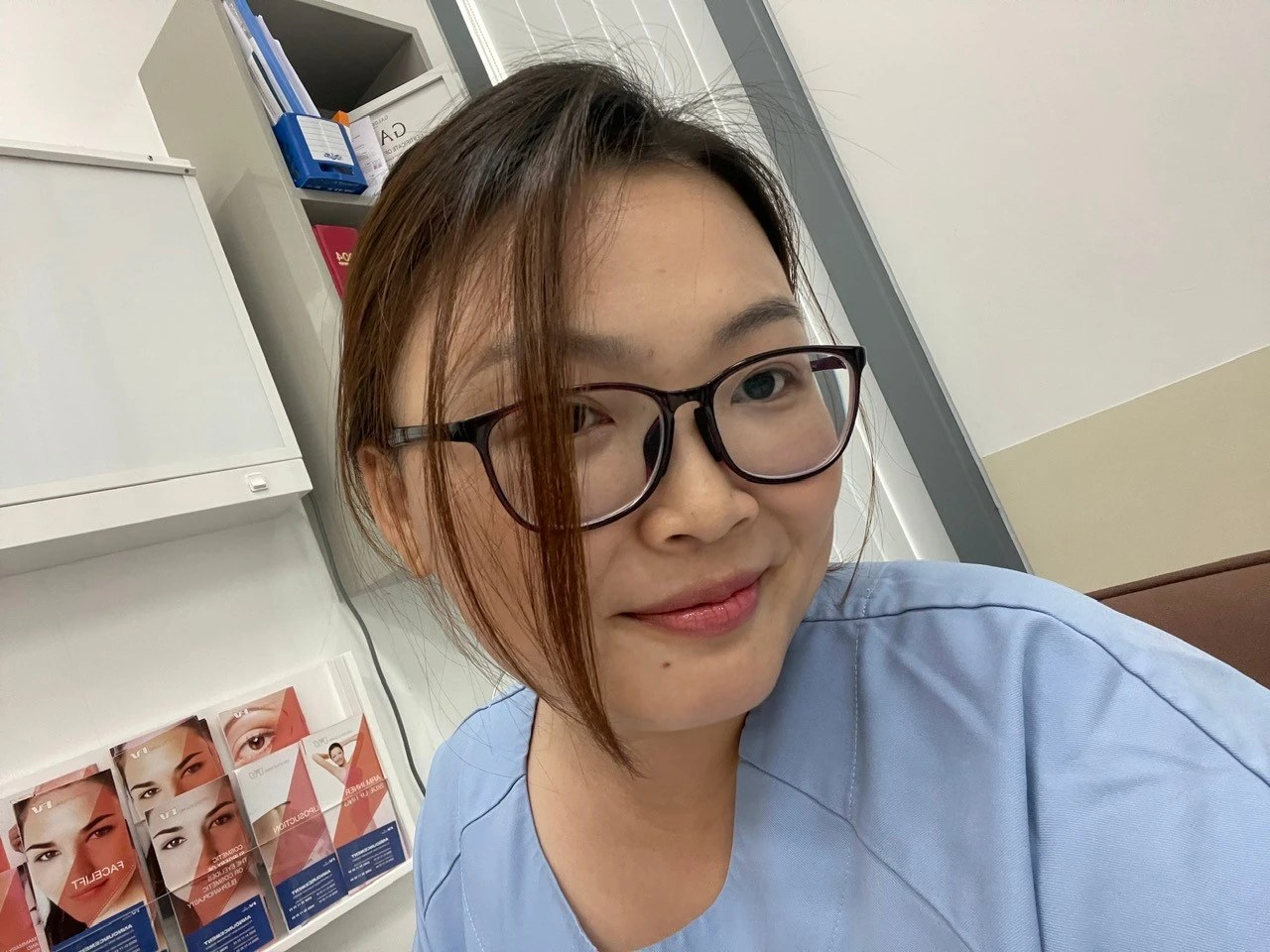
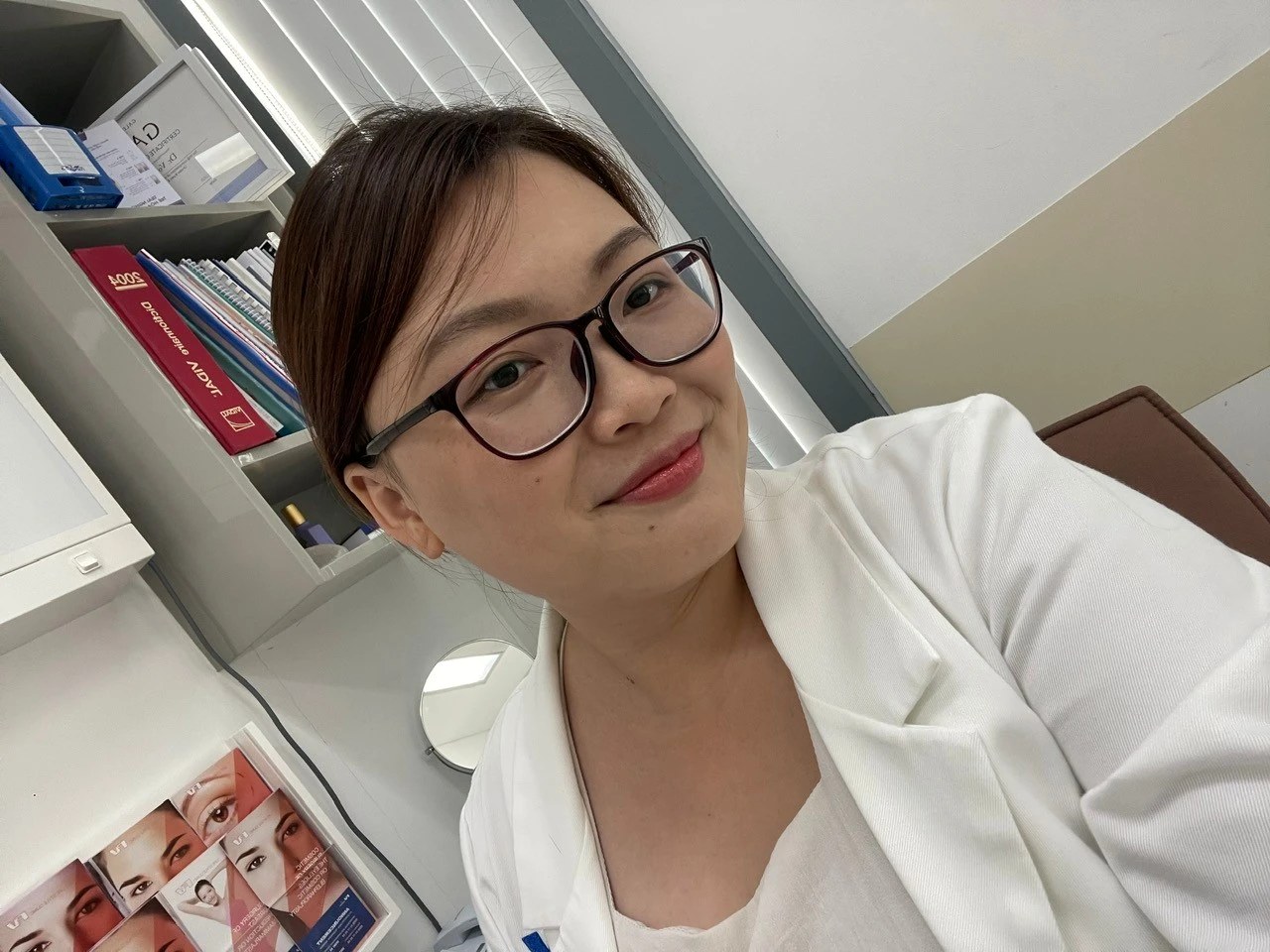
Dr Võ Ngọc Tú in the consultation room
Pl. IConsultation room · Ho Chi Minh City

Home · About · Dr Võ Ngọc Tú

Facial Rejuvenation & Regenerative Surgery

Võ Ngọc Tú

Restore your youth. Remain yourself.

Natural facial rejuvenation surgery in Ho Chi Minh City: facelift, eyelid rejuvenation and fat grafting.

Book a consultation

Rejuvenation surgery

Want your youth back? Start here.

Four signature treatments, chosen for one goal: a face that looks rested and fresh, and still unmistakably yours.

The signature approach

Lift where tissue has dropped, restore what time has taken away, and renew the skin with your own regenerative cells.

01FaceliftRepositions sagging tissue, refines facial contours

Repositions the deeper layers of the face and neck, so the jawline is defined again and the cheeks sit where they used to.

Right for you if

  • your cheeks and jawline have started to sag
  • the neck looks loose or lined
  • you want a lasting change, not a quick fix

Type SurgeryRecovery About 2–3 weeks

How it goes
Performed under general anaesthesia or deep sedation, usually 3–4 hours. Incisions are hidden around the ear and in the hairline; the deeper layers are lifted, not just the skin.
Aftercare
One night of observation is usual. Head raised, cool compresses, a light dressing for the first days; stitches out at about 1 week.
Possible risks
Swelling and bruising are expected. Less common: bleeding under the skin, temporary numbness, visible scars or asymmetry. Each is explained at your consultation.
Reference cost
Surgeon's fee: $4,000
Read more about facelift → Talk it through with Dr Tú
02Eyelid rejuvenation surgeryRejuvenates the eyes: under-eye bags, loose skin, brow lift

Depending on what your eyes need, one operation works towards four goals:

  1. Removing loose, excess skin from the upper and lower lids
  2. Taking out under-eye bags through the inside of the lid (conjunctiva) and grafting fat into the tear trough to fill the hollow
  3. Lifting a brow that has dropped with age, either directly above the brow or through the hairline
  4. Correcting a droopy lid caused by a stretched, weakened lid-lifting muscle

Right for you if

  • your upper lids feel heavy, with loose skin hooding the eye
  • you have bags, hollows or dark circles under the eyes
  • your brows sit lower than before, or your eyes look sleepy
  • people often say you look tired

Type SurgeryRecovery About 1–2 weeks

How it goes
Usually under local anaesthesia, sometimes with light sedation; the length depends on how much is done. Upper-lid incisions sit in the natural crease and lower-lid ones just under the lashes; bags are removed from inside the lid, leaving no outer scar. A brow lift uses an incision just above the brow or hidden at the hairline.
Aftercare
Cool compresses, head raised, eye ointment for a few days; stitches out at 5–7 days.
Possible risks
Swelling and bruising are common. Less common: dry eyes, slight asymmetry, a change in lower-lid shape, or uneven lid height needing a small adjustment. Your eye health is checked first.
Reference cost
Surgeon's fee: upper lid or direct brow lift $800 · lower lid $1,200 · revision $1,500
Read more about eyelid rejuvenation → Talk it through with Dr Tú
03Microfat graftingBring back lost volume

Your own fat, refined into tiny particles, restores fullness to hollow cheeks, temples and under-eye hollows. Soft, natural, and it ages with you.

Right for you if

  • your face looks thinner or tired
  • you have hollows under the eyes or at the temples
  • you prefer your own tissue to fillers

Type Minor surgeryRecovery About 1–2 weeks

How it goes
Fat is taken through tiny openings, usually from the abdomen or thighs, refined, and placed in very small amounts with fine cannulas. About 1–2 hours.
Aftercare
Swelling for 1–2 weeks. Do not massage or press the treated areas; light compression on the donor site.
Possible risks
Part of the fat is naturally absorbed, so a small top-up is sometimes needed. Less common: lumps, irregularities or infection.
Reference cost
Surgeon's fee: $500 per small area
Read more about microfat grafting → Talk it through with Dr Tú
04Nanofat cocktailRenew the skin itself

Nanofat from your own fat, blended with vitamin C to brighten, HA to hydrate and botox to soften fine lines, then carried into the skin of the face and neck with microneedling.

Right for you if

  • your skin looks dull, thin or crepey
  • you have fine lines or dark circles
  • you want a gentle, regenerative approach

Type Minor procedureRecovery A few days

How it goes
A small amount of fat is turned into nanofat, blended into the cocktail, then carried into the skin of the whole face, and the neck if needed, with microneedling.
Aftercare
Redness and mild swelling for a few days. Gentle skincare and sun protection.
Possible risks
Temporary redness, swelling or small bruises. Results build gradually over weeks.
Reference cost
Surgeon's fee: $1,200
Read more about nanofat cocktail → Talk it through with Dr Tú

Not sure which is right for you? That is exactly what the first consultation is for.

Talk it through with Dr Tú

Regenerative medicine

Potential must go with evidence

Regenerative medicine opens many lines of research in tissue care and rejuvenation. But not every new technology has proven clinical benefit. What matters is understanding the mechanism, the quality of evidence, and the limits and risks of each method.

Dr Tú is especially drawn to adipose-derived stem cells and SVF, and follows this research closely. Cell-based treatments are still being studied and are strictly regulated; only methods that are proven safe and legally permitted are used in practice.

  • INanofat & microfat
  • IIAutologous fat grafting
  • IIIPlatelet-rich plasma (PRP)
  • IVCell-based approaches & SVF
  • VBiostimulatory treatments
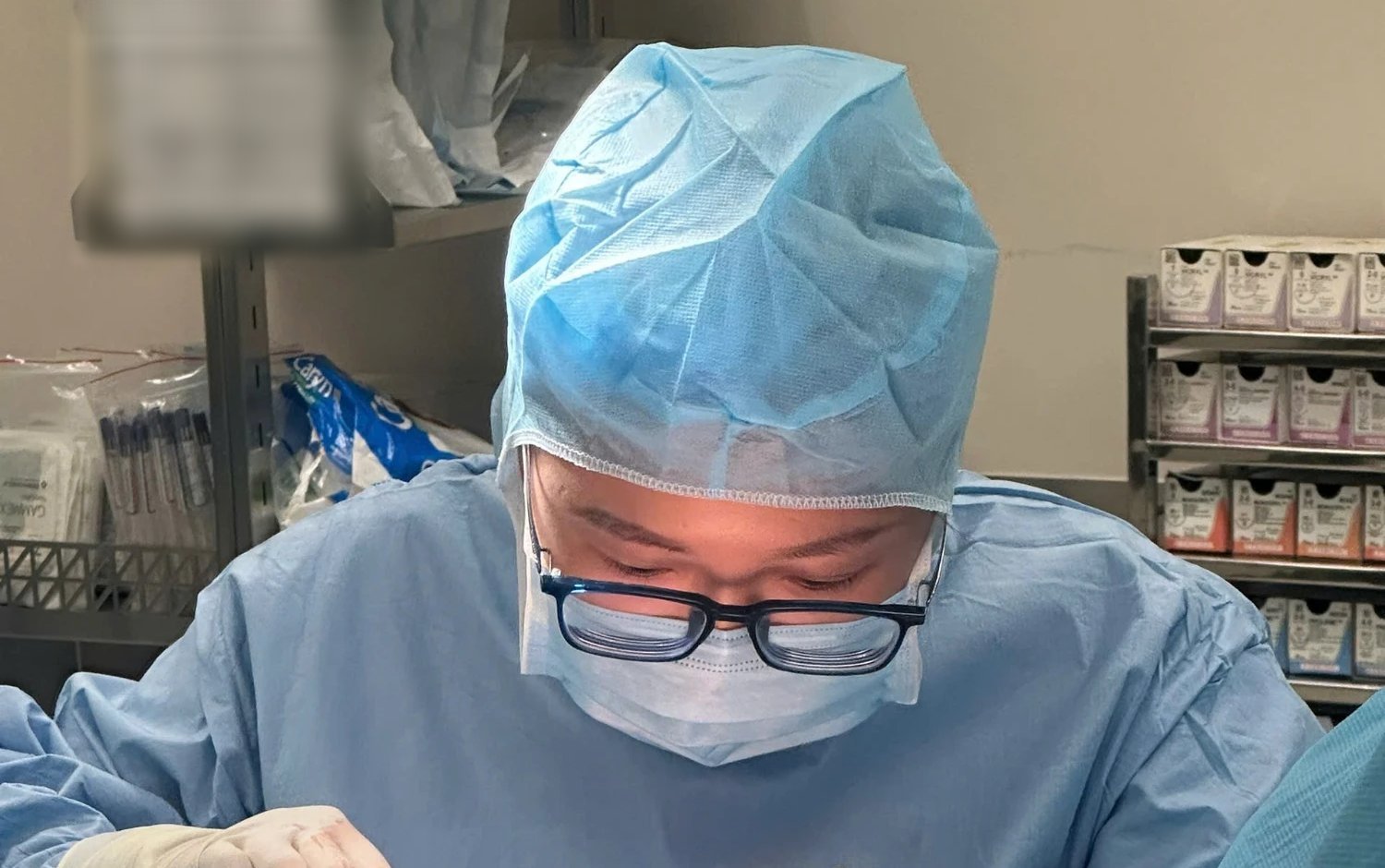
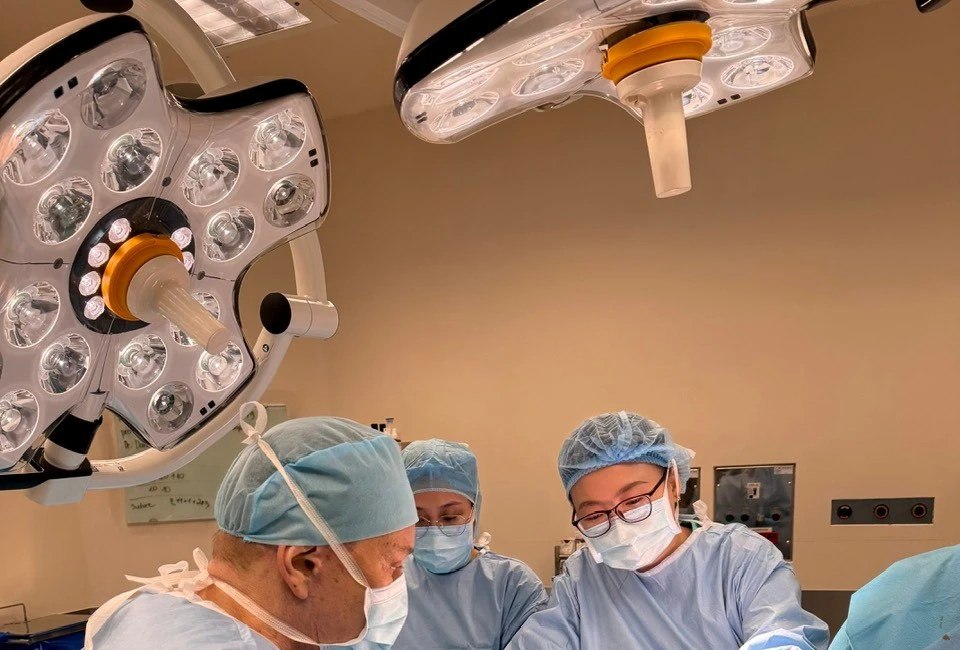
Dr Võ Ngọc Tú concentrating during surgery

Dr Võ Ngọc Tú · In theatre

Every detail matters.

Dr Võ Ngọc Tú

Your surgeon

Dr Võ Ngọc Tú

Dr Tú listens before examining. Every line of the face is observed closely, the small changes others tend to overlook are noticed, and everything is explained clearly and honestly, without promising more than surgery can give. For Dr Tú, rejuvenation is never about turning you into someone else, but about bringing back the freshness that was always yours.

Before aesthetic surgery, Dr Tú worked in breast surgical oncology and reconstruction, a field that teaches precision, respect for living tissue and safety above all. At FV LifeStyle, FV Hospital, Dr Tú then led consultations and minor procedures and took part in facelift, fat grafting and eyelid surgery.

Curious by nature and unafraid of a harder path, Dr Tú chose regenerative facial surgery while it was still rare in Vietnam: lifting tissue that has dropped instead of pulling the skin tight, and using your own fat, with its stem cells and growth factors, to restore volume and renew the skin. Rather than chasing every new technology, Dr Tú looks closely at which method truly helps, for whom, and under which conditions.

What Dr Tú hopes for most is simple: that when family and friends see you again, they notice how well you look, without being able to say what has changed.

  • Doctor of Medicine (MD), General MedicineHue University of Medicine and Pharmacy · 2019
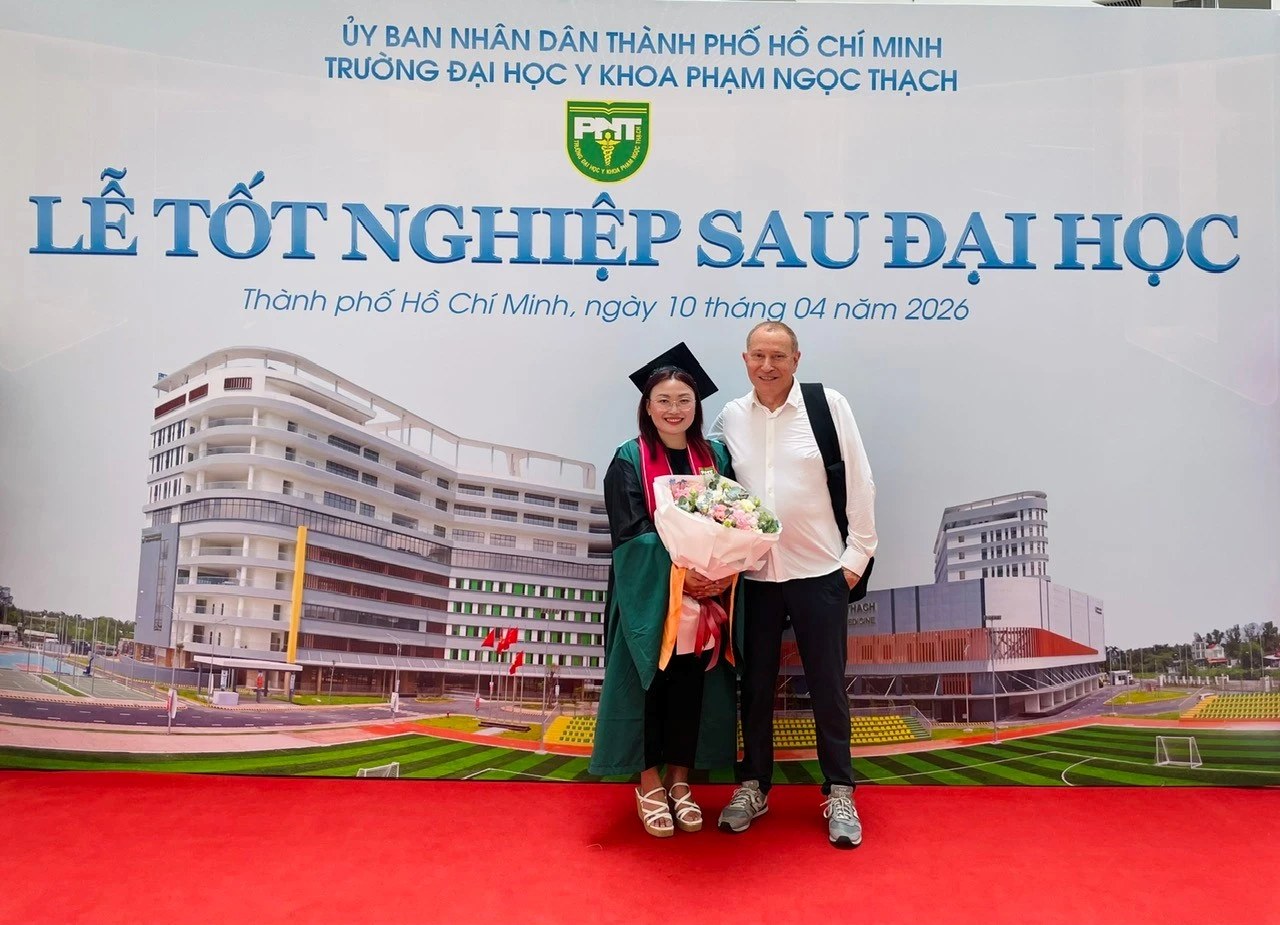
  • Specialist Level I in Plastic & Aesthetic SurgeryPham Ngoc Thach University of Medicine · 2023–2025, conferred 2026
  • Medical practising licence No. 013924/NA-CCHNNghệ An Department of Health · 2021. Scope: Surgery; Plastic & Aesthetic Surgery added in 2026
  • Plastic surgeon, FV LifeStyleFV Hospital, Ho Chi Minh City · 2024–2026
  • Laser Application in Dermatology certificateUniversity of Medicine and Pharmacy, Ho Chi Minh City · 2026
  • Associate member, ISAPS and IMCASInternational Society of Aesthetic Plastic Surgery · International Master Course on Aging ScienceView ISAPS member profile ↗
  • Admin, Young Plastic Surgeons Community VietnamA network of more than 2,000 young plastic surgeons
  • Planned advanced training: Istanbul and GhentIstanbul (2027) and Ghent (2027–2028). These are upcoming plans, not completed certifications.

Published research: PubMed 34429956

What guides my work

I

Your natural self

Every face has its own core of beauty. Treatment follows your anatomy and character, so you still look like you, only rested.

II

Always learning

From oncology to regenerative surgery, Dr Tú keeps studying with international societies and mentors, and reads the evidence before trying anything new.

III

Bold, within safe limits

Daring to think differently and to pursue a field still young in Vietnam, while never stepping outside clear indications, safety and the law.

IV

Empathy first

Listening before examining. Every worry is heard, every option explained honestly, and every patient treated as a person, not a procedure.

In theatre

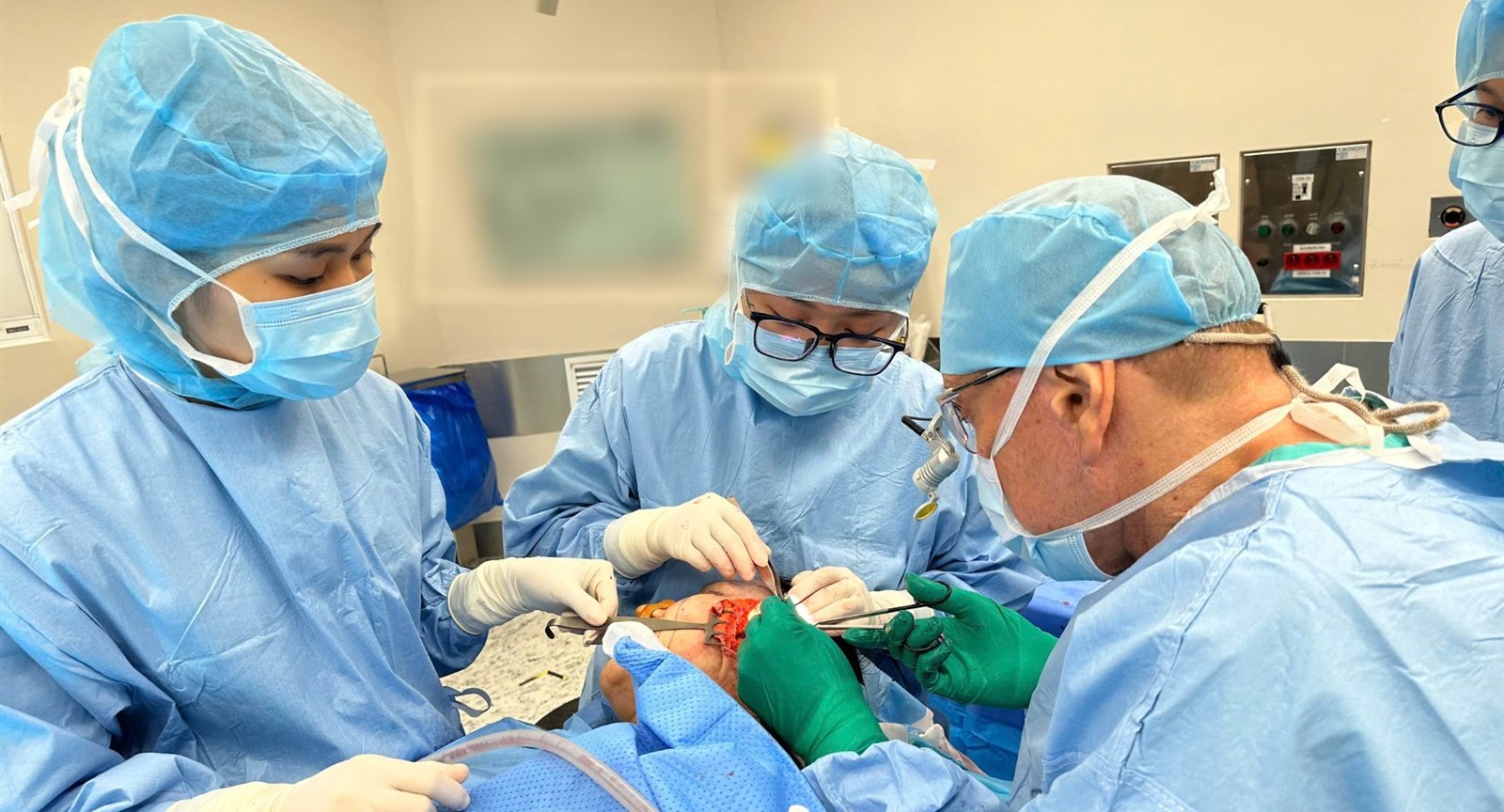
Dr Võ Ngọc Tú assisting in facial surgery
Pl. VIn theatre · facial surgery
Dr Võ Ngọc Tú operating
Pl. VIClosing with care
Dr Võ Ngọc Tú in profile during surgery
Pl. VIIEvery detail matters
Dr Võ Ngọc Tú working in a surgical team
Pl. VIIILearning within a surgical team
Dr Võ Ngọc Tú holding a needle holder
Pl. IXPrecision in every stitch

Sharing

Where doctor and patients speak openly

Behind every face there is a story. Here Dr Tú writes about the work and the questions it raises, and patients, with their consent, share what the journey felt like.

My story

"Have I taken the wrong path?"

A question that followed me as I chose regenerative facial surgery, a field that still has little structured training in Vietnam.

Dr Võ Ngọc Tú
Pl. IIHo Chi Minh City, 2024

Journal · Hanoi, 2026

PARS 2026: meeting my idol

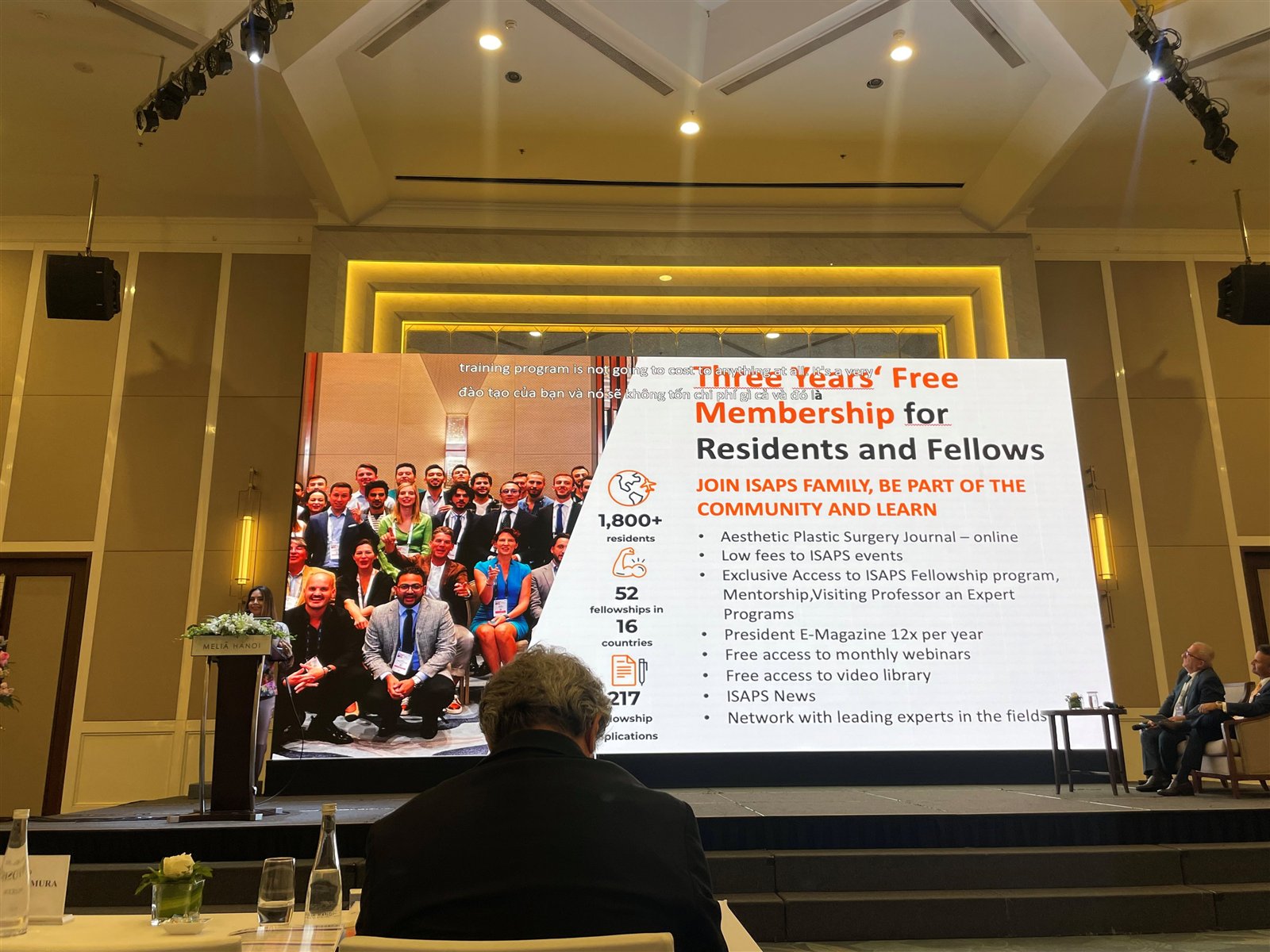
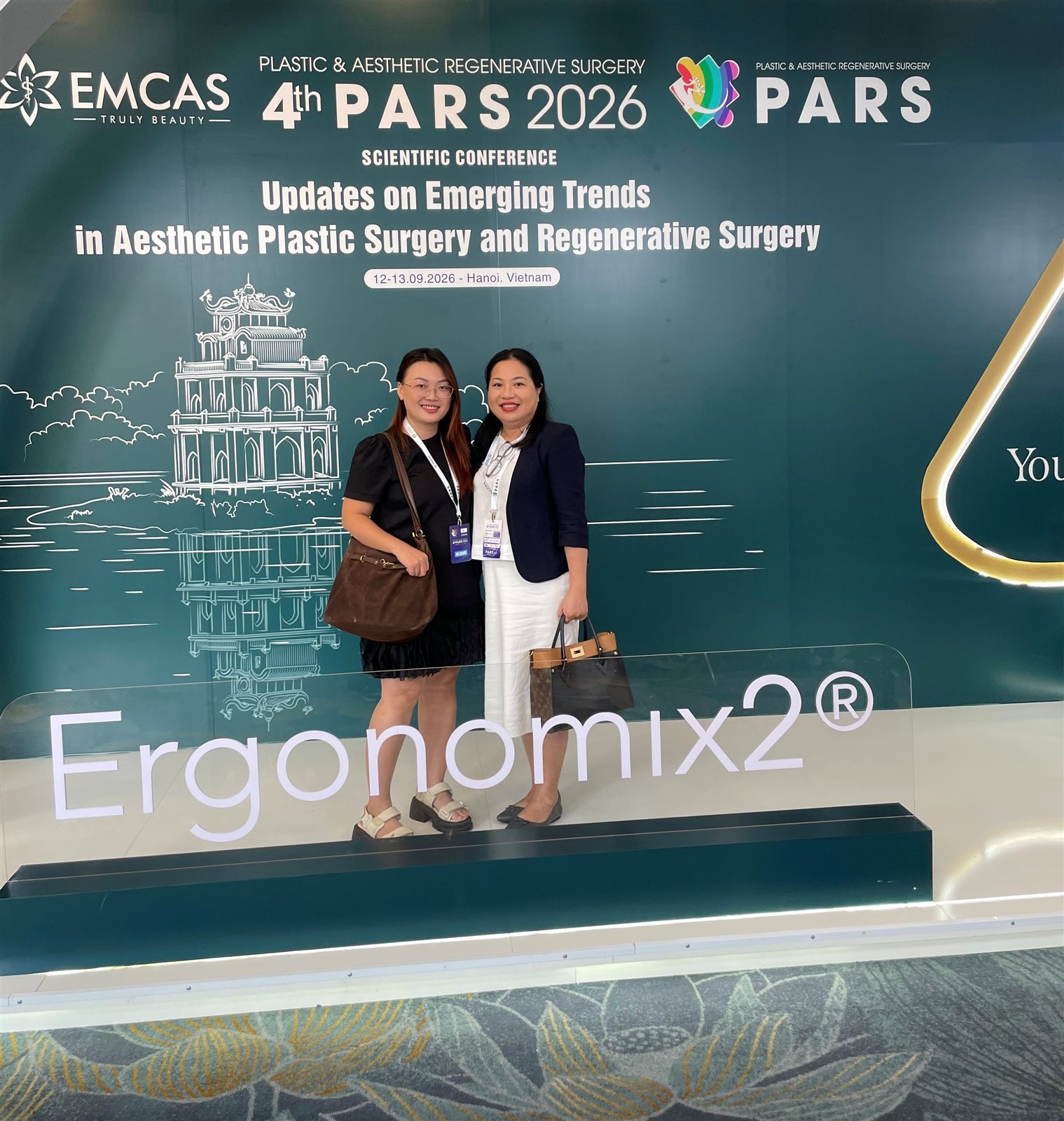
PARS 2026 is a congress on aesthetic plastic surgery and regenerative medicine. For the first time, Vietnam welcomed the world's leading teachers in this field to teach here, at home.

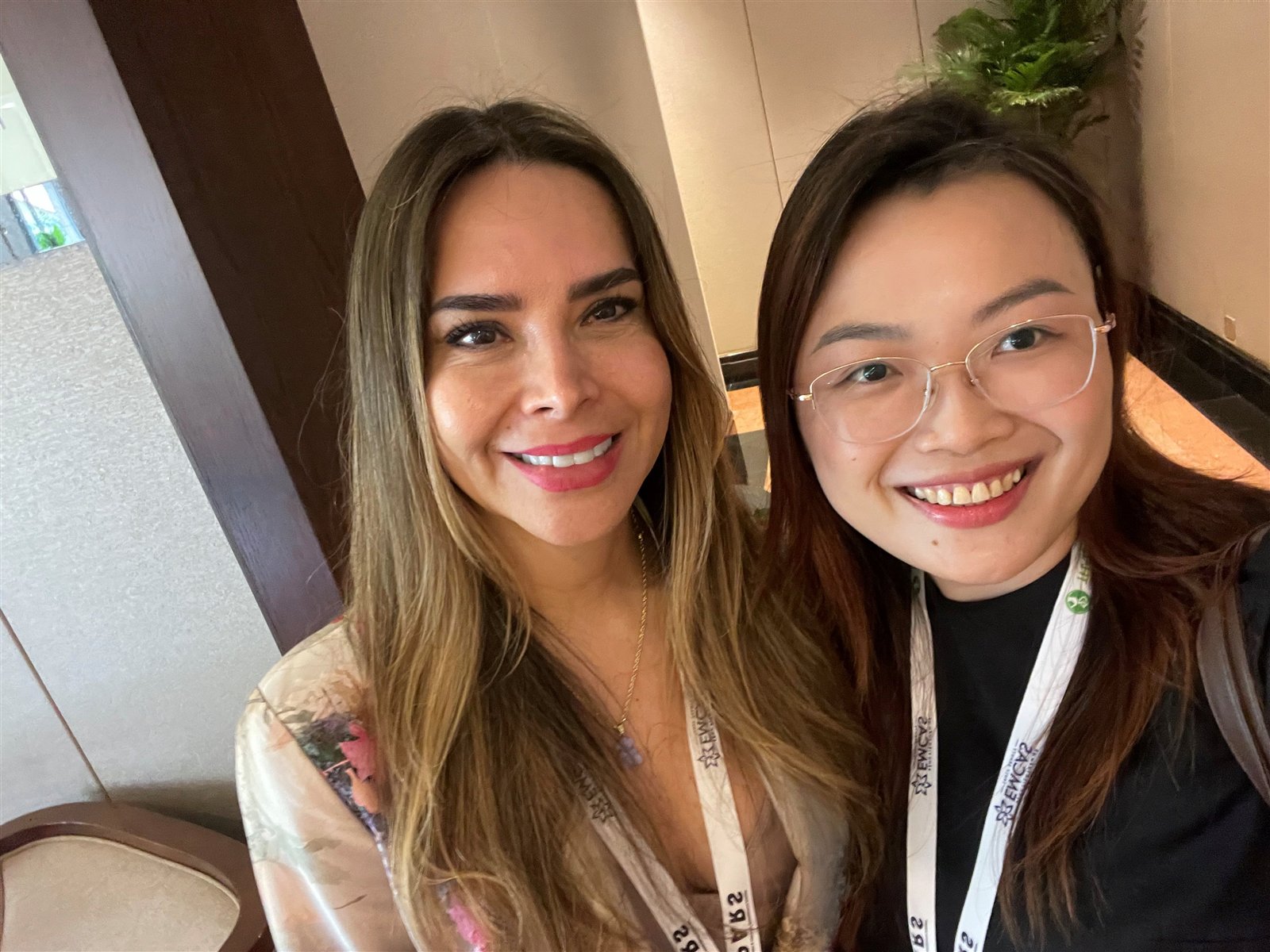
There I met Dr Bertha Torres Gomez, my idol. She is the ISAPS National Secretary Chair, past President of the Mexican Association of Plastic, Aesthetic and Reconstructive Surgery (AMCPER), and one of the organisers of the ISAPS World Congress 2026 in Cancún, Mexico, together with her husband, Dr Arturo Ramírez-Montañana, President of ISAPS. A beautiful, brave and brilliant woman, who has given so much to aesthetic surgery around the world.

I told her how much I admire her. Women surgeons are still few in the world, and very few have shown such courage and given as much as she has. That means even more in Vietnam, a country still deeply shaped by Confucian tradition.

"Travel one day's road, gain a basketful of wisdom."Võ Ngọc Tú


Journal · Bangkok, 2025

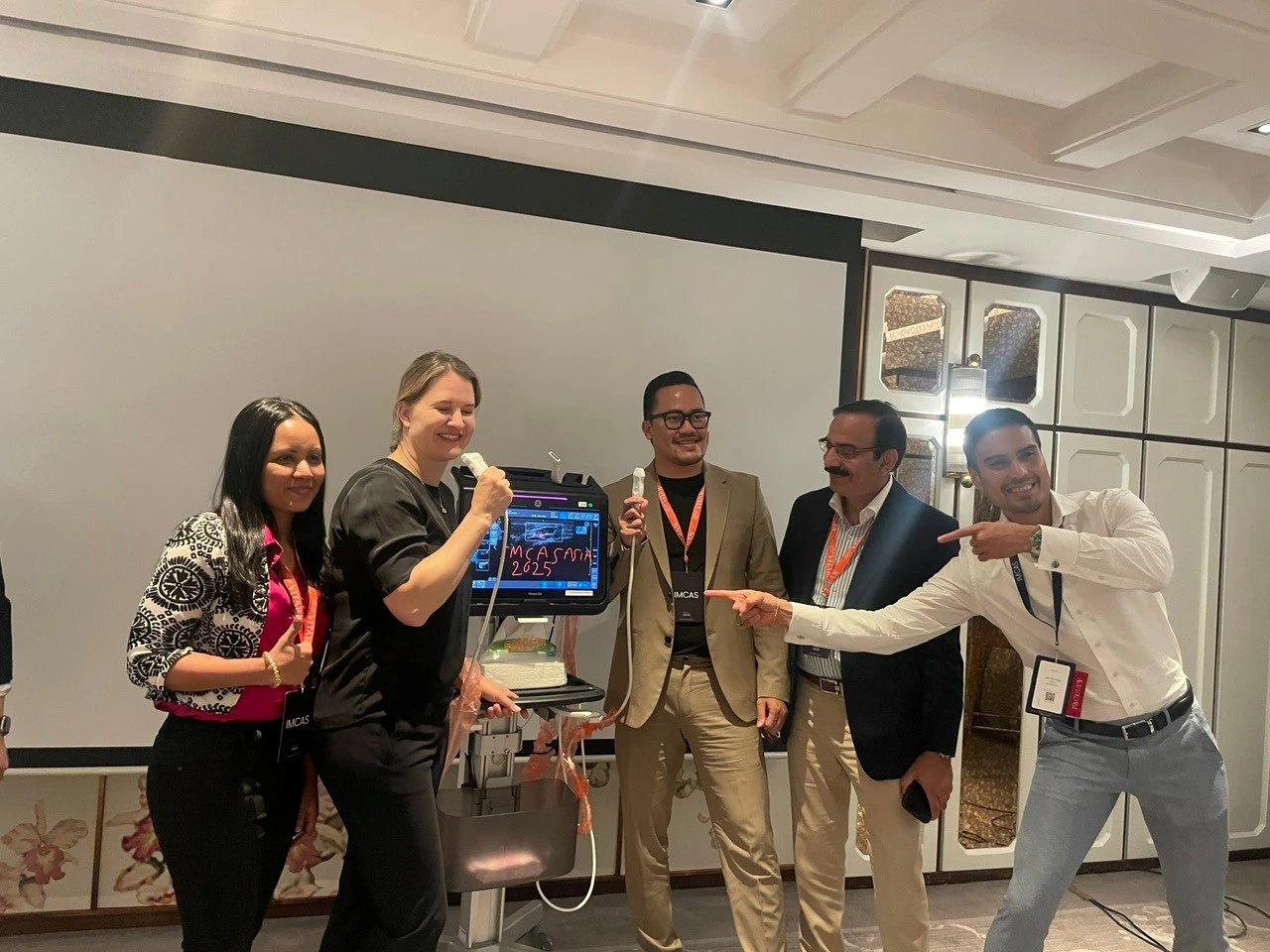
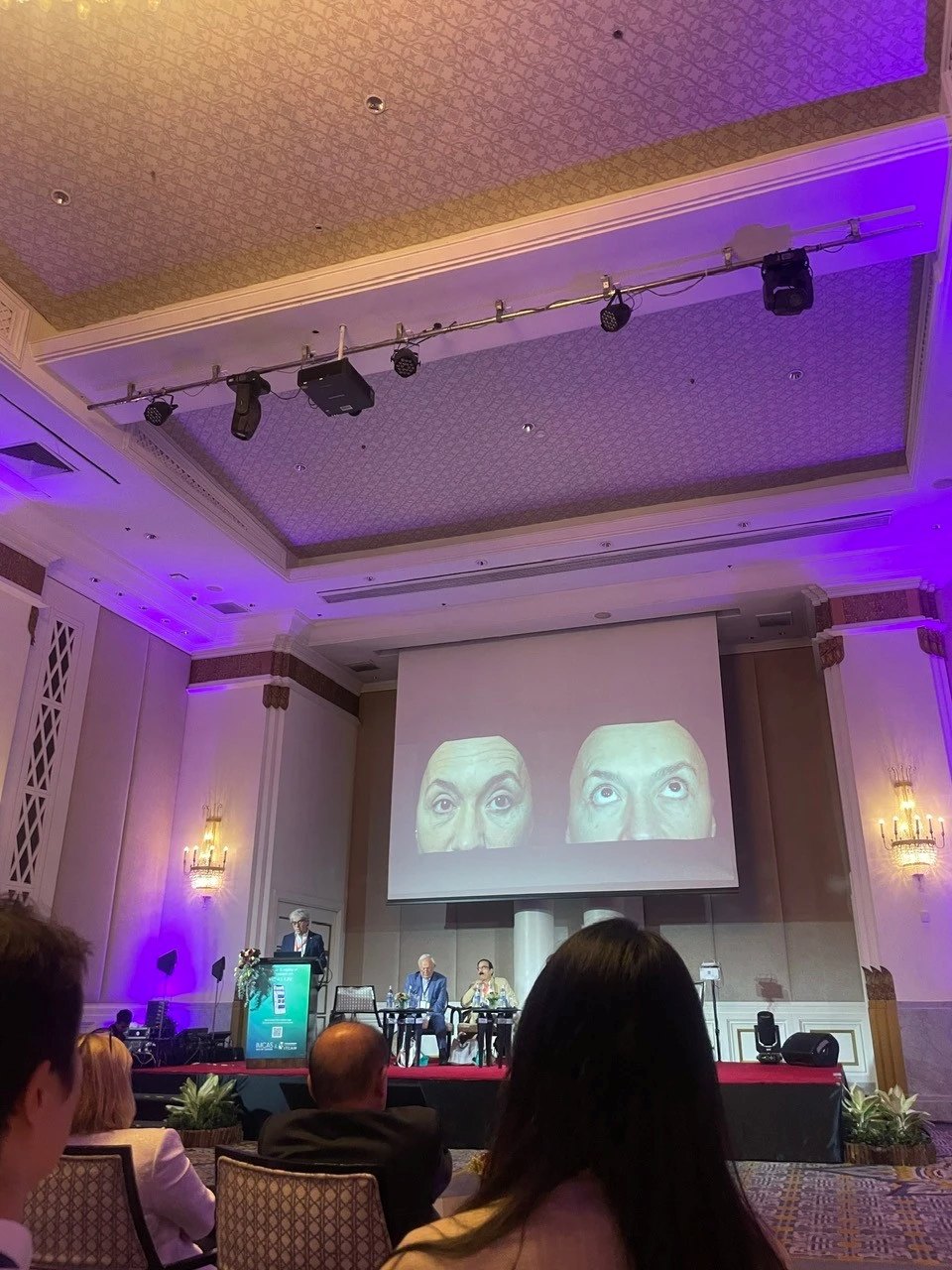
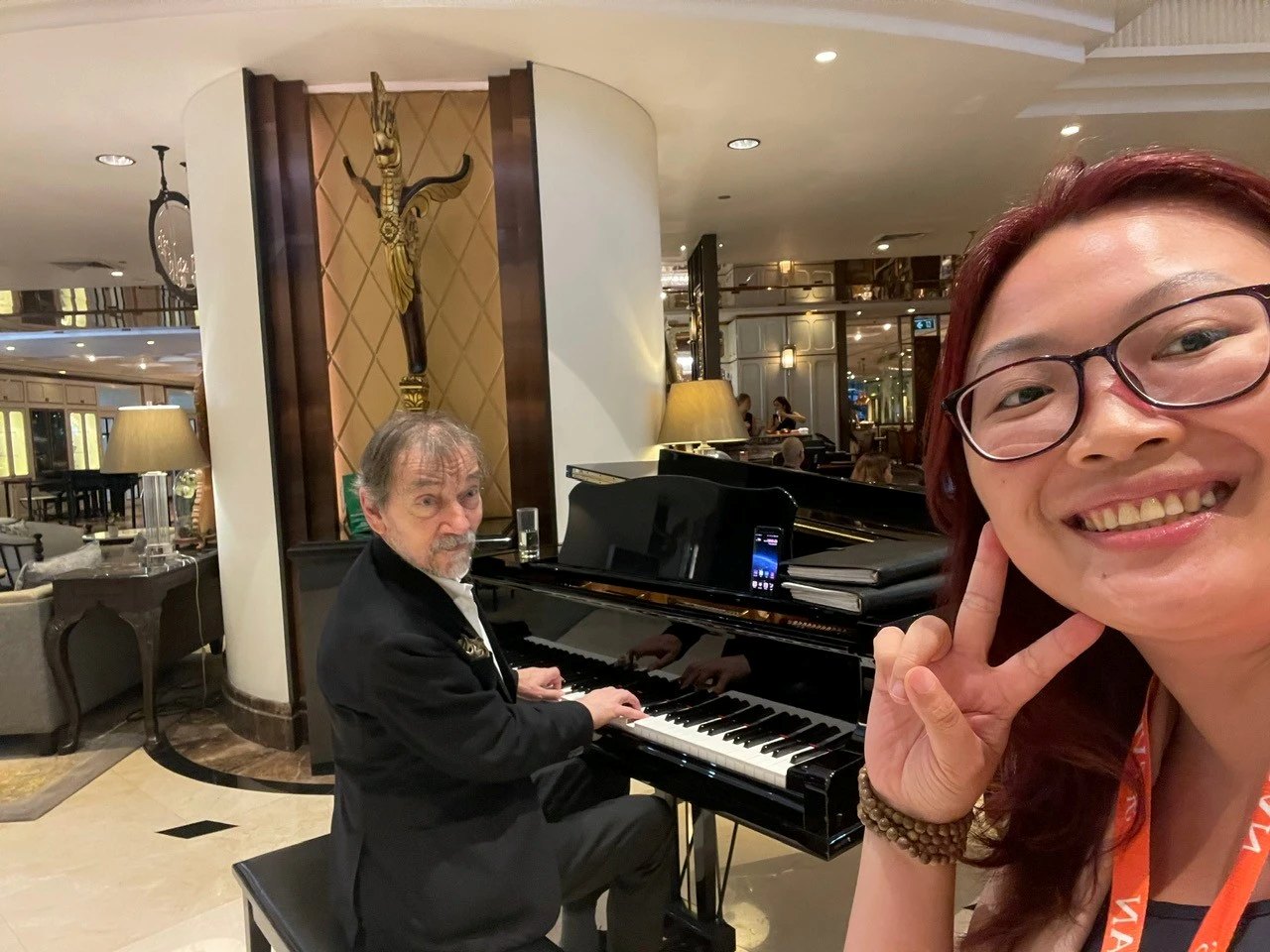
IMCAS Asia 2025: a young doctor's first

IMCAS Asia 2025 was the first major international congress I ever attended. Only three short days, yet it was the first time I found a kind of freedom: free to explore, free to learn, free to plan the trip myself and choose every session I wanted to attend.

Then came the unexpected, lucky encounters: with colleagues from all over the world, and with teachers who seemed to step straight out of the pages of a book. People whose books I had only ever read, I could now see, talk to and learn from in person.

So much joy, and so much tiredness from learning without a pause, but I lived those three days to the fullest. And the fourth day? That one was for enjoying Bangkok.

"Thank you, IMCAS Asia 2025, for a young doctor's very first experience."Võ Ngọc Tú

Behind the scenes

A day between the clinic and the theatre

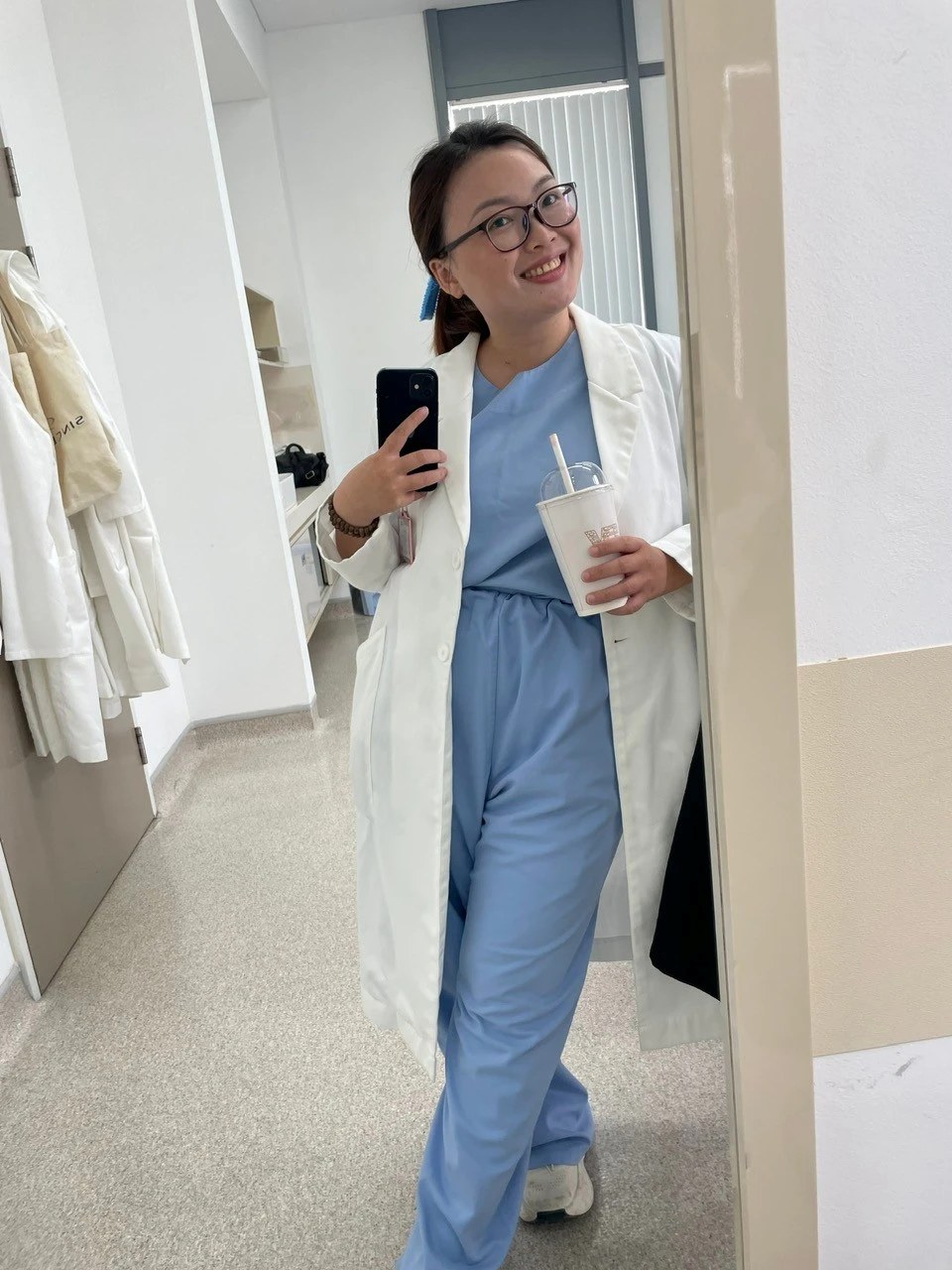
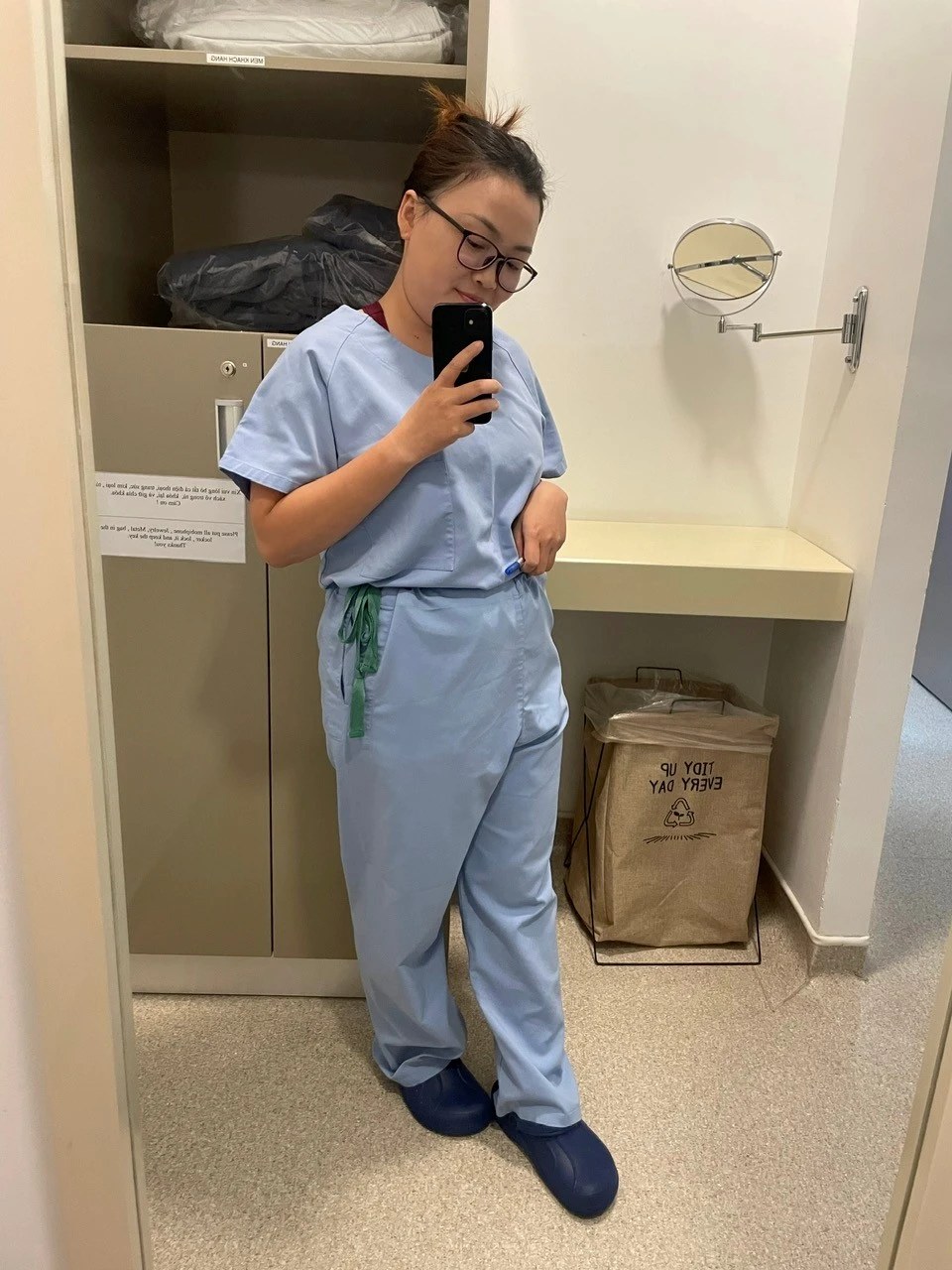
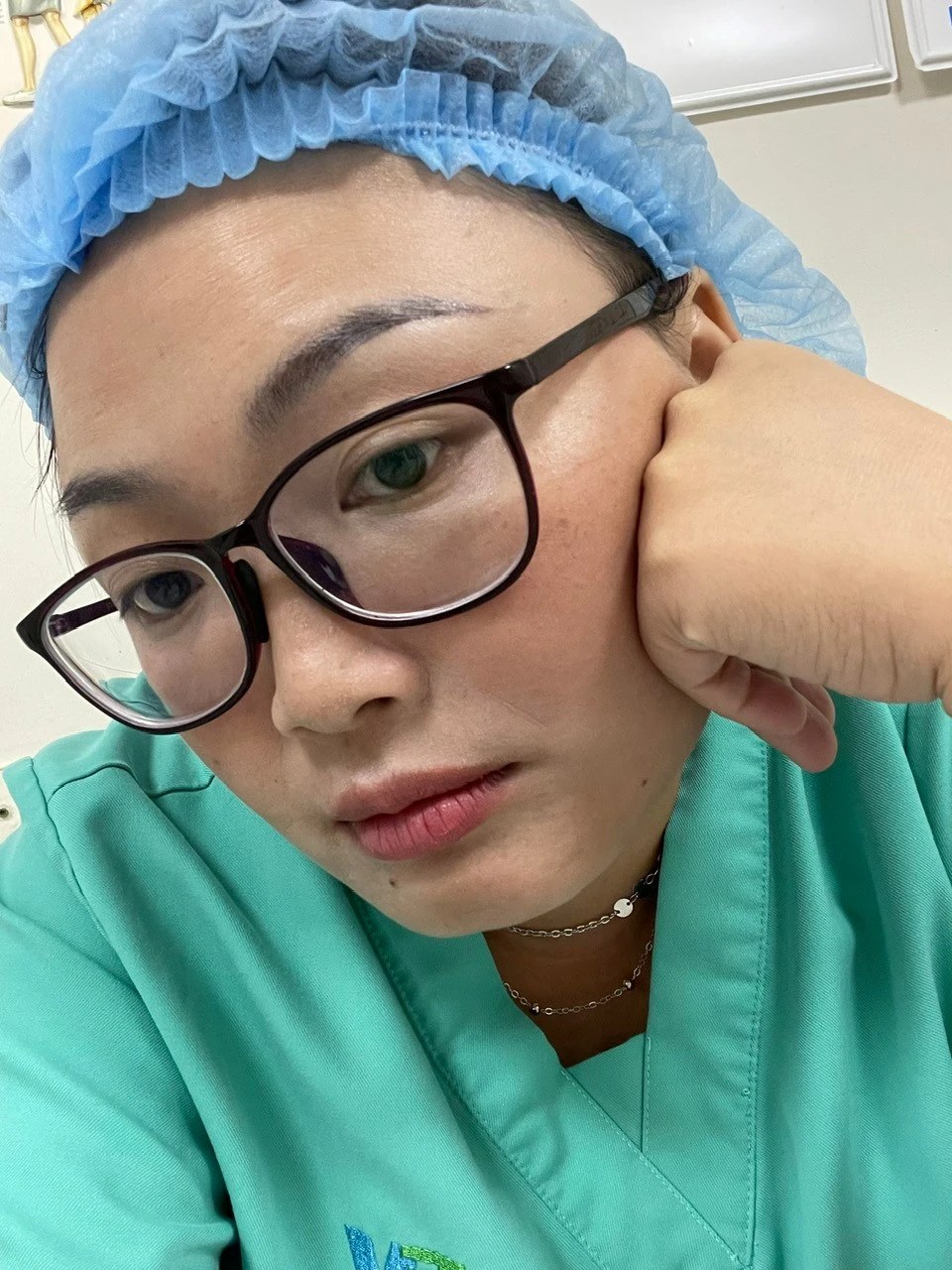
A white coat in the morning, blue scrubs by noon, and sometimes a quiet minute with my head in my hand between two operations. These are the ordinary moments behind every result.

Dr Tú in a white coat before morning consultations
Morning, before consultations
Dr Tú operating with the surgical team
In theatre, with the team
Dr Tú in scrubs, ready for theatre
Changed and ready for theatre
Dr Tú resting between operations
A minute's rest between two operations
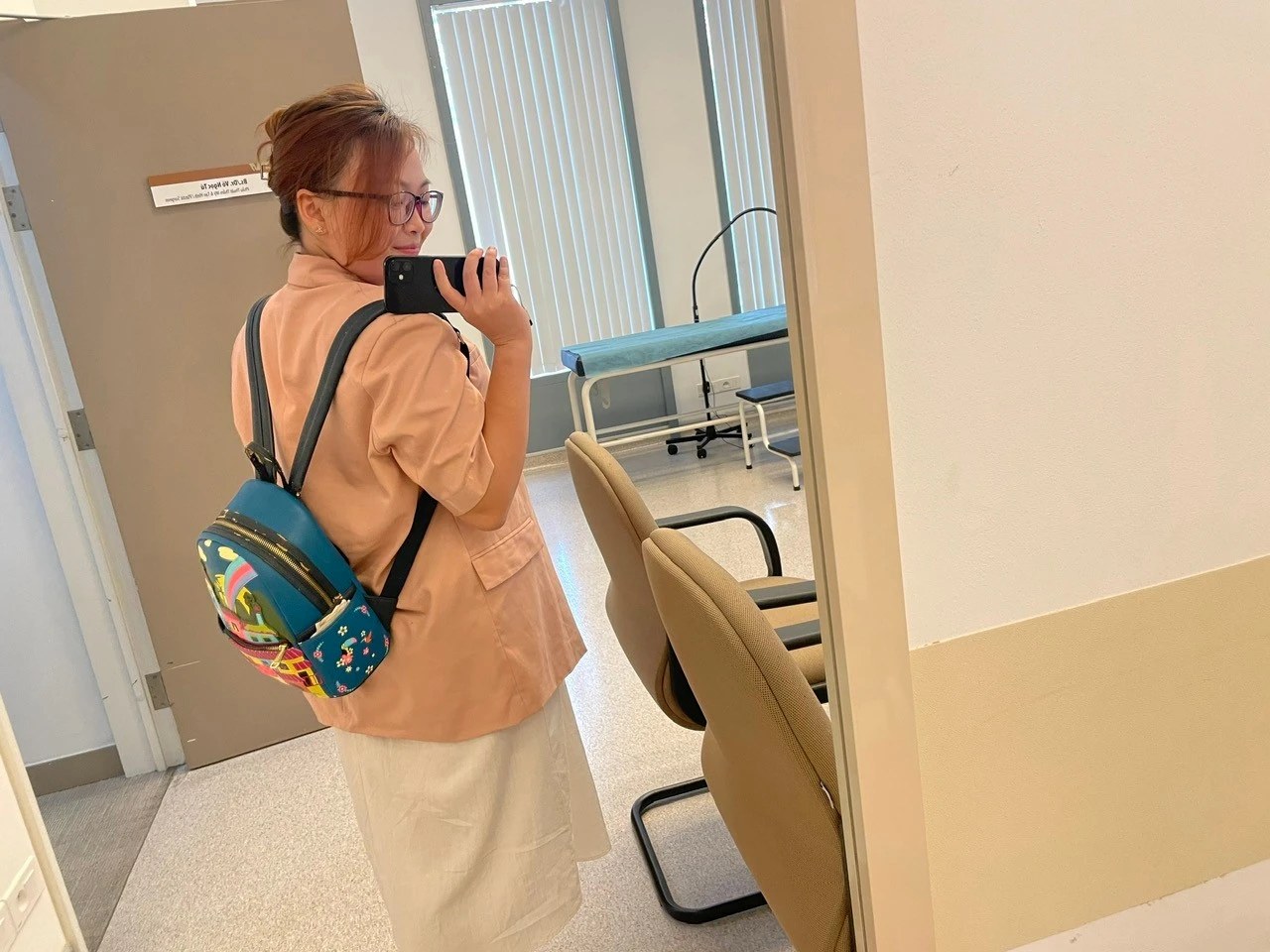
Dr Tú in the consultation room
Between consultations
Dr Tú leaving the clinic at the end of the day
End of the day, heading home

Patient stories

Every patient is a story of their own

Behind every procedure is a person, with their own worries, hopes and reasons for coming. These are some of their stories, shared with their permission.

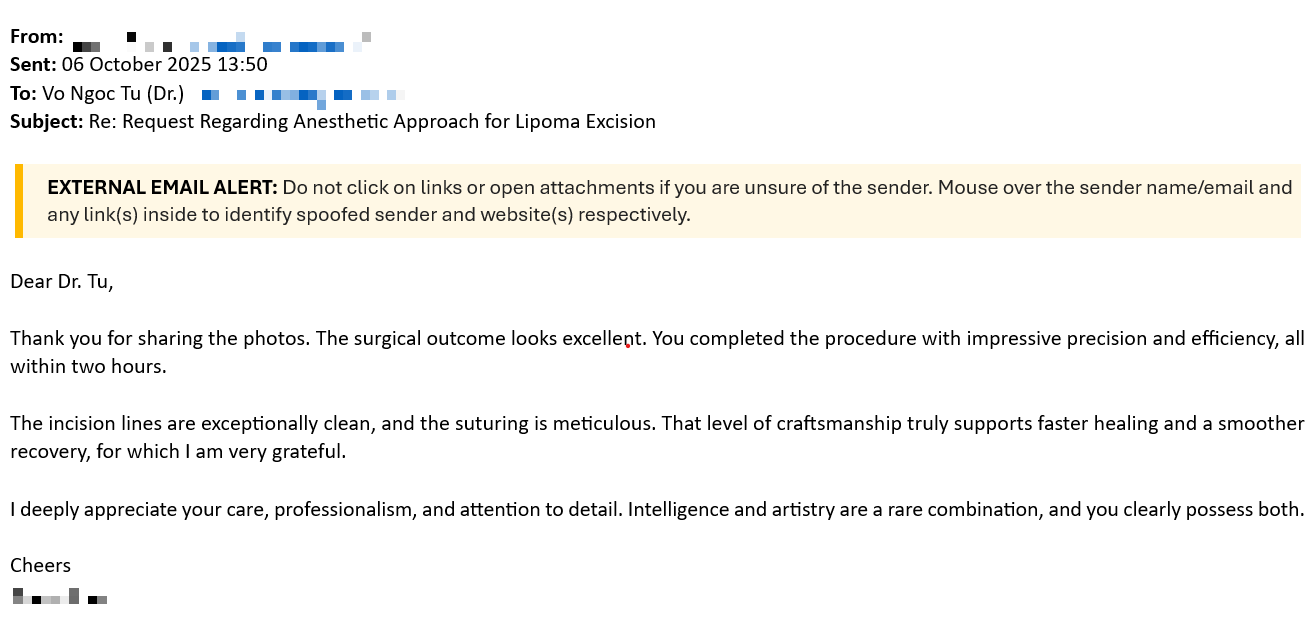
B. C. · Lipoma excision · October 2025

"Intelligence and artistry are a rare combination, and you clearly possess both."

"The incision lines are exceptionally clean, and the suturing is meticulous. That level of craftsmanship truly supports faster healing and a smoother recovery, for which I am very grateful."

Thank-you email from a patient, with names and email addresses blurred
Pl. IVOriginal email from the patient · personal details blurred

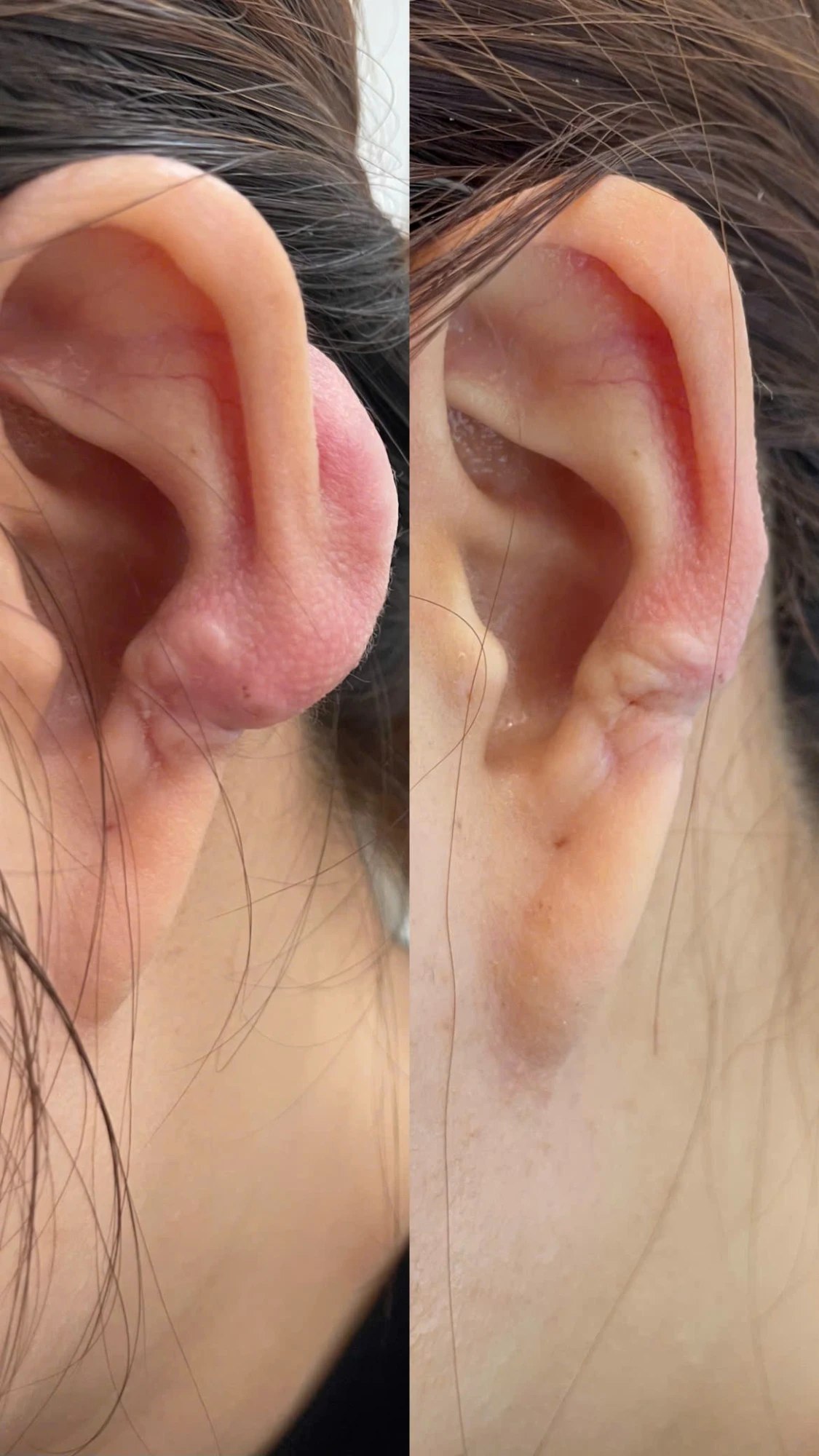
Ear keloid excision

She had her ears pierced, like so many women do. Unluckily, the piercing left a keloid. At first it was no bigger than a bean, then it slowly kept growing.

She tried steroid injections, but they did not help. She went through three operations to cut it out, and each time the scar came back bigger than before. By the time she came to Dr Tú, the keloid had grown into the cartilage of the ear, distorting its shape, itching and hurting. For years it had been a deep source of self-consciousness for her.

Dr Tú took a long time to explain everything carefully, and agreed to treat her only once she promised to come back for a check-up every month. With a keloid, cutting it out and reshaping the ear is only the first step. Steroid injections, regular pressure dressings and careful wound care must follow, if the scar is to have a chance of not coming back.

After long, honest conversations and a signed consent, doctor and patient placed their trust in each other. And so their journey together began.

"Thank you for trusting me."Dr Võ Ngọc Tú

Ear keloid excision, before and after BeforeAfter

Happy patient, happy doctor

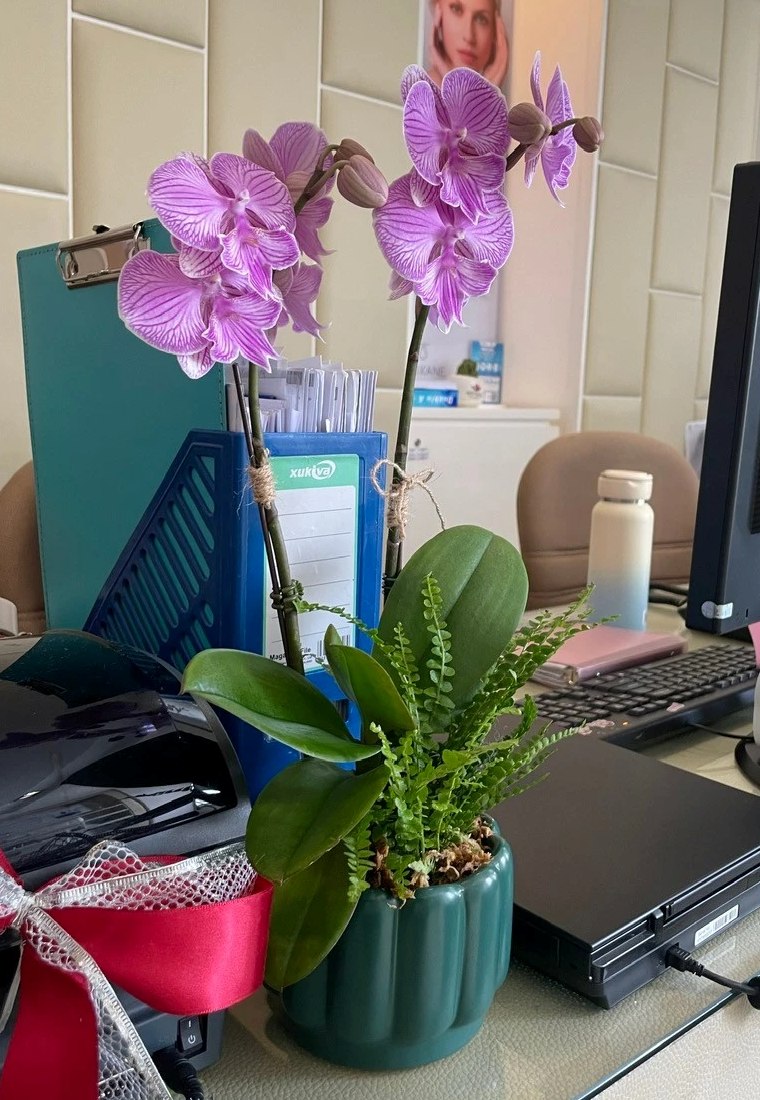
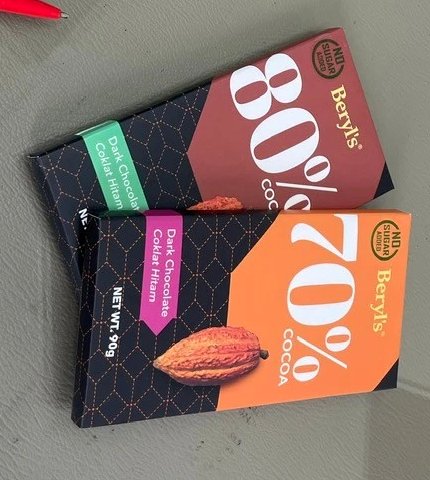
There is nothing better than a patient coming back for a post-operative check-up with a smile and a warm hug. A small orchid, a couple of chocolate bars: simple gifts, yet they carry a whole heart.

Moments like these are the quiet reward of every careful step, from the first consultation to the last follow-up.

"Happy patient… happy doctor."Dr Võ Ngọc Tú
An orchid given by a patient Chocolates given by a patient

Cases are published only with the patient's appropriate consent, with confidentiality protected and professional regulations followed.

Your voice

Send your story

Your story goes privately to Dr Tú. Nothing is published unless you agree. Please don't include sensitive photos or medical records.

This opens your email app with your message ready to send.

Medical knowledge

Understand before you decide

Short, plain-language notes to help you understand your face and the treatments you may be considering.

IWhy does the face age?3 min read

Facial ageing happens in several layers at once. The skin becomes thinner and less elastic. The fat pads beneath it shrink and slide downwards. The ligaments that hold soft tissue in place loosen, and even the bone of the eye sockets and jaw slowly changes shape.

That is why a single treatment rarely solves everything. Lifting deals with sagging, fat grafting restores lost volume, and skin treatments improve texture. A good plan starts by working out which layer is responsible for what you see in the mirror.

IIFat grafting: how it works and how long it lasts3 min read

Fat is gently taken from an area such as the abdomen or thighs through a thin cannula, cleaned and prepared, then placed in small amounts where volume has been lost: the temples, cheeks, around the eyes or the lips.

Part of the transferred fat is naturally absorbed during the first few months. The fat that establishes a blood supply usually stays long term and ages with you. Because the amount that survives varies from person to person, a second, smaller session is sometimes needed.

IIIMicrofat, nanofat and stem cells: what is the difference?4 min read

Microfat is fat filtered into very small particles, so it can restore volume in delicate areas. Nanofat is fat that has been emulsified until it no longer adds volume; it is used to improve skin quality, fine lines and dark circles.

Fat tissue naturally contains regenerative cells, including adipose-derived stem cells. They are one reason fat grafting is studied for skin rejuvenation. Research in this field is promising but still developing, and treatments based on isolated or cultured stem cells are strictly regulated. Be cautious of any offer that promises "stem cell" miracles.

IVKeloids: why they come back3 min read

A keloid is scar tissue that keeps growing beyond the edges of the original wound. It often appears on the earlobes, chest and shoulders, and some people are more prone to it, sometimes within the same family.

When a keloid is only cut out, it has a high chance of returning. That is why surgery is usually combined with other steps afterwards, such as steroid injections, pressure, silicone sheets and regular follow-up. Treating a keloid is a process, not a single day.

VIBefore your operation: a simple checklist3 min read

In the weeks before: stop smoking and vaping, cut down on alcohol, and tell Dr Tú about every medicine, vitamin and herbal supplement you take. Some, such as aspirin, fish oil and certain herbs, increase bleeding; only stop them if your doctor advises.

On the day: come with clean skin and no make-up, wear a top that buttons at the front, and arrange for someone to take you home and stay with you the first night. At home, have cold packs, extra pillows to keep your head raised, and soft foods ready.

This information is general and does not replace an in-person consultation.

After surgery

Your recovery, step by step

What most people can expect, and when. Your own timeline is given to you at every check-up.

  1. Days 1–3

    A light compression dressing; swelling and bruising are at their peak. Rest with your head raised. A drain, if used, usually comes out in 1–2 days.

  2. Week 1

    Some stitches come out at 5–7 days. Gentle hair washing and light walking at home.

  3. Week 2

    Swelling and bruising are much less. Many people return to desk work and social plans, with light make-up.

  4. Weeks 3–4

    Most daily activities are back, including light exercise.

  5. Month 3

    Residual swelling has mostly gone and the scars are fading.

  6. Months 6–12

    The result settles and the scars mature.

These times are a guide, not a promise: everyone heals at their own pace. Contact Dr Tú straight away if swelling grows quickly on one side, pain gets worse, you have a fever, or a wound oozes.

Questions

Good to know

Will I still look like myself?

Yes. The approach is to restore, not reshape. The aim is a result that looks rested and natural.

Am I a good candidate for surgery?

It depends on your health, anatomy, wishes and an in-person assessment by the doctor. It can't be decided from photos or messages alone.

How long is recovery?

It depends on the treatment, from a few days for injections to around two to three weeks for a facelift. You'll get a personal timeline in your plan.

How should I prepare for a consultation?

Bring your medical history, the medicines you take, any allergies, previous procedures or surgery, and the questions you want to ask.

Can I be assessed and treated online only?

An online conversation can give you initial information, but it doesn't replace an in-person examination when a diagnosis or treatment decision is needed.

What does it cost?

Costs depend on your treatment plan. You'll receive a full written quote after your consultation.

International patients · Online care

Care that starts before you travel

Dr Tú consults in English and Vietnamese. For patients abroad or far from Ho Chi Minh City, the journey begins online and continues after you go home.

  1. 01

    Online consultation

    A video call to hear your goals, look at your concerns together and explain the options. It gives initial guidance; the final plan is confirmed in person.

  2. 02

    Travel and examination

    Plan your trip around the surgery date. You are examined in person first, before anything is confirmed.

  3. 03

    Follow-up from home

    Video follow-ups after you return, so your recovery is still looked after.

Your journey

From first visit to final result

  1. Consultation

    We listen to your goals, examine your face and talk through every option honestly.

  2. Your plan

    You receive a written plan with the procedure, timing, recovery and costs.

  3. Treatment

    Performed with care in an accredited setting, with you informed at every step.

  4. Aftercare

    Scheduled check-ups and direct contact with our team until you're fully healed.

Indicative fees

Surgical prices are the surgeon's fee. Non-surgical prices include the product. Everything is given to you in writing before any treatment.

  • Consultation$30
  • Eyelid rejuvenation surgery$800 – $1,500depending on your indication
  • Facelift$4,000surgeon's fee
  • Microfat grafting$500per small area · surgeon's fee
  • Nanofat cocktail$1,200surgeon's fee
  • HA fillerfrom $420 / 1 ccTeoxane · Restylane $460 · Juvéderm $500
  • Skin boosterfrom $270Restylane Skinboosters · Rejuran Eye $270 · Rejuran Healer $350
  • CO2 Fractional laser$190 / sessionfull face · course of 3: $460
  • Chemical peel$40 / session
  • Laser mole removal$20 / session
  • Botoxfrom $80Nabota · from $300 for Allergan, Merz

Take the first step

Start with a conversation

Write to Dr Tú with a few lines about what concerns you. You will receive a reply about the next step and where an in-person consultation can take place.

ClinicTo be announced · Ho Chi Minh City

or write directly to

Email

vongoctu.plasticsurgeon@gmail.com

Please don't send sensitive photos or medical records by email. A first message only needs your concern and how to reach you.

Explore

Rejuvenation surgery

Facelift

Repositions sagging tissue and refines your facial contours.

Why a facelift?

Over time, the tissues that support the face slowly loosen and slide downwards under the pull of gravity. It shows first along the jaw: small jowls appear and the once clean line from chin to ear becomes blurred. Many people notice it when they look down at their phone, or in a photo taken from the side that they did not expect.

The corners of the mouth drop a little too, which can make you look tired, sad or even stern when you feel nothing of the sort. Under the chin the skin loosens, the angle between jaw and neck softens and folds begin to form.

Creams, injections and devices are often promised as the answer. They can improve the skin, but they cannot lift tissue that has dropped back to where it belongs. Once the jawline and neck have visibly sagged, a well-performed facelift is the method that corrects it effectively and safely.

The aim is not a different face, but your own face, rested, the way people remember you.

What it is

A facelift is more than tightening skin. The supporting layer underneath is lifted back into place, so your face returns to its younger shape without looking pulled.

Pulling the skin backwards

The older way. The face is tighter but can look stiff and "windswept".

Lifting the SMAS straight up

Dr Tú's way. Tissue goes back to where it was, and the face looks natural and balanced.

  • A shorter scar

    Because the lift is vertical, early sagging can often be treated through a short incision in front of the ear that does not need to continue behind it. Less surgery means less swelling and a faster return to everyday life. When the neck has loosened more, the incision is extended so the neck can be lifted too.

  • Safety first

    Safety guides every choice. The nerves that move your face run in the deeper layers, so the technique is chosen to give a natural, lasting result while keeping those structures protected.

  • Volume restored with your own fat

    Sagging rarely comes alone: with age the face also loses volume. That is why a facelift is often combined with microfat to restore fullness and nanofat to refresh the skin, in the same operation.

Lifted, never pulled.

How it goes

  1. 1
    Anaesthesia

    The operation is usually performed under general anaesthesia or deep sedation and takes about 3–4 hours.

  2. 2
    Incision and lift

    The incision follows the natural crease in front of the ear and continues into the hairline, so the scar heals almost invisibly. Through it, the deeper layer is lifted upwards and secured, the excess skin is trimmed, and the wound is closed in layers.

  3. 3
    Fat grafting when needed

    During the same operation, if parts of your face have hollowed, a little of your own fat is taken and grafted where fullness has been lost: the temples, forehead, cheeks, nose-to-mouth lines, under-eye hollows, marionette lines, lips and chin. Your own fat both restores volume and helps the tissue look younger, so the result feels soft and natural. Nanofat is also placed under the skin to help the wounds heal and freshen the skin.

Aftercare

What recovery usually looks like:

  1. Day 1

    You stay one night to be monitored. Keep your head raised and use cool compresses.

  2. Days 2–3

    Swelling is at its peak and the jaw feels tight. Simple pain relief such as paracetamol is usually enough.

  3. Day 7

    The stitches are removed.

  4. Weeks 2–3

    Most people are back at work and enjoying social life.

  5. Months 3–6

    The final result has settled.

  6. 1 year

    The scars keep fading until they are hard to see.

Possible complications

Every operation is planned and performed with great care, but as with any surgery, complications can occur. You will be told about each one honestly before you decide.

Asymmetry
Slight differences between the two sides are normal in the first weeks while swelling settles.
Bleeding
Uncommon. If a collection of blood forms under the skin, it is usually treated promptly with a small procedure.
Temporary numbness or nerve weakness
Numbness around the ears and cheeks is common and recovers over weeks to months. Weakness of a facial nerve branch is rare and usually temporary.
Healing of the skin edge
Rarely, a small area of skin heals slowly and forms a crust. The risk is much higher in smokers, which is why stopping smoking beforehand matters.

Cost

  • Facelift$4,000
  • Microfat grafting, added to the facelift$500 / small area
  • Nanofat cocktail, added to the facelift$1,200

The price shown is the surgeon's fee. Other costs are confirmed at your consultation and given to you in writing before anything is booked.

Book a facelift consultation

Want to read more?

Scientific studies, in English, for those who would like to go deeper:

Before and after photos will be added here, shared with each patient's written consent.

Rejuvenation surgery

Eyelid rejuvenation

Rejuvenates the eyes: softens bags, tightens loose skin, lifts the brow.

Why eyelid rejuvenation?

The eyes are often the first place people notice tiredness. Skin on the upper lid loosens and folds, fat under the eyes pushes forward into bags, and the area between lid and cheek hollows out.

Eye creams and fillers can soften this a little, but excess skin and fat bags need surgery to be truly corrected.

Done well, nobody sees the surgery, only that you look rested.

What it is

Every pair of eyes ages in its own way, so there is no single formula. At your consultation, Dr Tú looks closely at each part: the skin, the fat, the hollows, the brows and the muscle that opens the eye. From there, surgery usually works towards four goals, chosen according to what your eyes really need.

Only trimming eyelid skin

The lids look neater, but a dropped brow, hollows or a droopy lid remain, and the eyes still look tired.

Rejuvenating the whole eye area

Dr Tú's way. Skin, fat, hollows, brow and lid muscle are looked at together, so the result feels complete and natural.

  • 1
    Tidying loose skin

    Over the years, the skin of the upper and lower lids stretches and loosens, a little like fabric that has been worn for a long time. Dr Tú removes just the right amount of excess skin, so the lids look neat and light while still opening and closing naturally. Upper-lid incisions sit in the natural crease and lower-lid incisions just under the lashes, so once healed they are very hard to see.

  • 2
    Removing bags, filling hollows

    Under-eye bags are the fat around the eye pushing forward. Dr Tú removes this fat through the inside of the lower lid (the conjunctiva), so there is no scar on the outside. The groove that runs from the inner corner of the eye towards the cheek, the tear trough that makes you look short of sleep, is then filled with your own fat, so lid and cheek blend smoothly again.

  • 3
    Lifting the brow

    Sometimes the eyes feel heavy not because of the lids, but because the whole brow has dropped with age and is pressing down on them. Trimming eyelid skin alone is not enough then. Dr Tú lifts the brow back to where it belongs, in one of two ways:

    Direct brow lift

    The incision sits right along the upper edge of the brow, so the scar follows the line of the brow hairs. It lifts precisely and suits brows that have dropped a lot.

    Hairline brow lift

    The incision is hidden at the hairline above the forehead, so the scar stays out of sight in the hair. It lifts the brow and forehead together.

  • 4
    Treating a droopy lid

    Some eyes still look sleepy even after the extra skin is gone. The reason is the levator, the muscle that opens the eye, which has stretched and weakened over time, so the lid edge drops and covers part of the iris. Dr Tú tightens and repositions this muscle, so the eyes open wider and look bright and balanced again.

  • Extra care for dark circles

    For dark circles and thin skin under the eyes, nanofat together with skin-rejuvenating laser helps the skin look brighter and thicker. It can be done during the operation or afterwards, so the whole eye area looks fresh.

Rested eyes, still your own gaze.

How it goes

  1. 1
    Eye check

    Your eye health and tear function are checked before surgery.

  2. 2
    Anaesthesia

    Usually performed under local anaesthesia, sometimes with light sedation; about 1–2 hours.

  3. 3
    Hidden incisions

    Upper-lid incisions sit in the natural crease and lower-lid incisions just under the lashes. Bags are removed through the inside of the lid (the conjunctiva), leaving no outer scar. If the brow is lifted, the incision runs along the upper edge of the brow or is hidden at the hairline.

Aftercare

What recovery usually looks like:

  1. Day 1

    You go home the same day. Cool compresses and a raised head help the swelling settle.

  2. Days 1–5

    Eye ointment is used; vision may be slightly blurry from it.

  3. Days 5–7

    The stitches are removed.

  4. Weeks 1–2

    Most people are back at work.

  5. After your check-up

    Contact lenses and exercise can resume.

  6. Month 3

    The final result has settled.

Possible complications

Eyelid surgery is common and well tolerated, but complications can occur. Each one is explained before you decide.

Dry or watery eyes
Common for a few weeks and usually settles with drops.
Asymmetry
Slight differences between the eyes are normal while swelling settles; a small revision is rarely needed.
Change in lower-lid shape
Rarely the lower lid pulls down slightly. Careful planning and support techniques keep this risk low.
Bleeding
Uncommon. Any bleeding behind the eye needs urgent review, which is why you are given clear instructions on what to watch for.

Cost

  • Upper eyelid, or direct brow lift$800
  • Lower eyelid$1,200
  • Revision eyelid surgery$1,500

The price shown is the surgeon's fee. Other costs are confirmed at your consultation and given to you in writing before anything is booked.

Book an eyelid consultation

Want to read more?

Scientific studies, in English, for those who would like to go deeper:

Before and after photos will be added here, shared with each patient's written consent.

Rejuvenation surgery

Microfat grafting

Restore lost volume with your own tissue.

Why microfat grafting?

With age the face loses volume: cheeks flatten, temples hollow and the under-eye area sinks. The face looks thinner and more tired than you feel.

Fat is the face's natural filler. Using your own fat, refined into tiny particles, restores fullness softly and lasts long term once it settles.

For many years, fat was seen simply as a filler. Research in recent years has shown much more: fat tissue holds stem cells, growth factors and the stromal vascular fraction (SVF), which can help regenerate and reawaken the tissues around them, and the skin above. So fat does not only restore volume, it also helps the face look younger from within.

No foreign material, just your own tissue in the right place.

What it is

Microfat is your own fat, refined into tiny particles, used to softly refill the places that have hollowed with time.

Filler

Quick and useful for small touches, but it dissolves over time and needs repeating.

Your own fat (microfat)

Your own tissue: soft, natural, and long-lasting once it has settled.

The same budget, two very different choices

For about $500 you could have 1 cc of Juvéderm filler, or microfat grafting for one small area when it is added to your surgery. Filler fades after about 6–12 months and has to be repeated. Your own fat, once it has taken, stays for the long term, feels soft like your own tissue, and brings its stem cells and growth factors to help the skin look younger. To be honest: part of the fat is naturally absorbed, so a small top-up is sometimes needed.

  • Where the fat comes from

    A small amount of fat is taken from an area such as the abdomen or thighs, cleaned and filtered into very small particles (microfat).

  • Where it is placed

    These particles are placed in tiny amounts with fine cannulas into the temples, cheeks, under-eye hollows or smile lines. It works well on its own or together with a facelift or eyelid surgery.

Your own tissue, in the right place.

How it goes

  1. 1
    Anaesthesia

    Usually performed under local anaesthesia with sedation; about 1–2 hours.

  2. 2
    Harvesting and placing the fat

    Fat is harvested through openings of a few millimetres, so there are no visible scars. It is then processed and placed in many fine passes for an even, natural result.

  3. 3
    A little extra

    A little extra is placed to allow for the part your body naturally absorbs.

Aftercare

What recovery usually looks like:

  1. Day 1

    You go home the same day. The treated areas swell and may bruise; the donor site feels sore, like after exercise.

  2. First weeks

    Do not massage or press the grafted areas. Light compression on the donor site helps comfort.

  3. Weeks 1–2

    Most of the swelling has settled.

  4. Month 3

    The surviving fat is stable and the result can be judged.

Possible complications

Fat grafting is gentle, but like any procedure it has risks, which are explained before you decide.

Partial absorption
Some of the fat is absorbed naturally. Occasionally a small top-up is needed for the best result.
Lumps or irregularities
Rare when fat is placed in fine amounts; they usually soften with time or can be corrected.
Infection
Uncommon and treated promptly.
Fat in a blood vessel
A very rare but serious risk, kept as low as possible with blunt cannulas, slow injection and detailed knowledge of facial anatomy.

Cost

Surgeon's fee: $500 per small area.

The price shown is the surgeon's fee. Other costs are confirmed at your consultation and given to you in writing before anything is booked.

Book a fat grafting consultation

Want to read more?

Scientific studies, in English, for those who would like to go deeper:

Before and after photos will be added here, shared with each patient's written consent.

Rejuvenation surgery

Nanofat cocktail

Renew the skin with your own regenerative cells.

Why a nanofat cocktail?

Not every sign of ageing is about sagging or volume. Thin, dull or crepey skin, fine lines and dark circles come from the skin itself.

Fat tissue contains regenerative cells. Emulsified into nanofat, it no longer adds volume but can improve the quality of the skin from within.

A gentle, regenerative way to bring light back to the skin.

What it is

Nanofat does not add volume. It works on the quality of your skin from within.

Microfat

Small fat particles that restore volume where the face has hollowed.

Nanofat

Fat emulsified into a fine liquid that helps skin look brighter, smoother and more even.

  • What makes it a "cocktail"

    A small amount of your fat is emulsified and filtered into nanofat, a fine liquid rich in regenerative cells. Dr Tú then blends it with three ingredients, each with its own job:

    Vitamin C

    Brightens the skin and evens out its tone.

    Hyaluronic acid (HA)

    Hydrates deeply, so the skin looks plump and smooth.

    Botox

    Softens fine, crinkly lines on the surface of the skin.

    Together with nanofat, this blend is what we call a nanofat cocktail.

  • Where it is used

    The whole face, and also the neck when its skin has aged. Nanofat cocktail can be done on its own or together with microfat or a facelift.

  • Safe and proven

    Research into regenerative cells is promising and still developing; Dr Tú uses only methods that are proven safe and legally permitted.

Skin that glows from within.

How it goes

  1. 1
    Anaesthesia

    Performed under local anaesthesia; about 1 hour.

  2. 2
    Preparing the cocktail

    Fat is harvested through a tiny opening and turned into nanofat during the same visit, then blended with vitamin C, HA and botox.

  3. 3
    Microneedling

    The cocktail is spread over the skin and carried into it with microneedling: thousands of tiny channels let it reach the deeper layers, and they also wake up the skin's own renewal.

Aftercare

What recovery usually looks like:

  1. First few days

    Mild redness and swelling, sometimes a small bruise.

  2. After a few days

    Make-up is usually fine. Use gentle skincare and careful sun protection.

  3. Weeks to months

    The skin keeps improving; some people benefit from one more session.

Possible complications

Nanofat is a gentle procedure with few risks, explained before you decide.

Redness and swelling
Common and temporary.
Bruising
Small bruises fade within about a week.
Uneven result
Occasionally an area improves less; a top-up session can even it out.
Infection
Rare with sterile technique.

Cost

Surgeon's fee: $1,200.

The price shown is the surgeon's fee. Other costs are confirmed at your consultation and given to you in writing before anything is booked.

Book a nanofat consultation

Want to read more?

Scientific studies, in English, for those who would like to go deeper:

Before and after photos will be added here, shared with each patient's written consent.

Non-surgical

Botox

Relaxing the right muscles, for a face that looks rested and natural.

Why Botox?

Many people come to Dr Tú with worries that sound very familiar. "Everyone keeps asking if something is wrong, but I feel fine." Two deep lines between the brows make the face look cross all the time. Someone else avoids photos because the jaw has grown square, or because every smile shows too much gum. Another hesitates to shake hands, because the palms are always damp.

Most of these concerns do not come from the skin, but from muscles that work too hard: the frown muscle that contracts thousands of times a day, the chewing muscle that grows from clenching, the small muscle that pulls the corners of the mouth down. Sweat glands, too, can work far more than they need to.

Botox helps these muscles and glands relax just enough. Used in the right place and at the right dose, it softens lines, refines contours and reduces sweating, while your face keeps every one of its expressions.

The aim is a face at rest, never a face that cannot move.

What it is

Botox (botulinum toxin type A) is a purified protein. In very small doses it briefly quietens the signal from a nerve to a muscle or a sweat gland. The muscle relaxes and the line softens; the gland makes less sweat. The effect is entirely temporary and fades over time.

At Dr Tú's clinic, Botox is used for:

Softening lines
  • Frown lines between the brows (glabellar)
  • Forehead lines
  • Crow's feet
  • Bunny lines on the nose
  • Neck lines
Refining contours
  • Slimming a square jaw
  • A cleaner jawline
  • Lifting the corners of the mouth (DAO muscle)
  • Reducing a gummy smile
  • A neater nose (depressor septi and nasal flaring muscles)
  • A gentle brow lift
Beyond aesthetics
  • Underarm sweating and body odour
  • Sweaty hands and feet
  • Oily facial skin
  • No need to fear a "frozen" face

    Many people hesitate because they are afraid of looking frozen. Dr Tú chooses the right dose for each person, with one guiding principle: relax the muscles just enough to soften the lines that expression creates, while you still smile, frown and express yourself completely naturally.

  • Genuine products only

    Only licensed products of clearly known origin are used, stored and prepared to medical standards.

  • Preventing early ageing

    Used well, Botox is remarkably safe and effective. Started early, when lines appear only as you move, it keeps them from settling into permanent creases over the years: a gentle and effective way to prevent early ageing.

How it goes

  1. 1
    Examination

    Dr Tú looks at your face at rest and in motion to find the muscles to treat and the right dose. Your health and any medication are checked first.

  2. 2
    The injections

    The skin is cleaned and numbing cream can be applied. Each point takes only a few seconds with a very fine needle.

  3. 3
    Check-up at 2 weeks

    Dr Tú checks the result and fine-tunes it if needed.

Aftercare

  1. Right after

    A few small bumps may show, gone within 15–30 minutes. Normal life straight away.

  2. First 4 hours

    Do not lie face down, rub the area or bend over for long.

  3. First 24 hours

    Avoid hard exercise, saunas and alcohol.

  4. Days 3–7

    The effect begins to show.

  5. Week 2

    Check-up and fine-tuning if needed.

  6. Months 3–6

    The effect fades gradually; a repeat treatment can be planned.

Possible complications

Botox is one of the most studied treatments in aesthetic medicine and is very safe in experienced hands. It is not given during pregnancy or breastfeeding, or to people with certain nerve and muscle conditions.

Bruising or swelling
A small bruise at an injection point, gone within days.
Mild headache
Sometimes in the first day, and short-lived.
Heavy lid or uneven brow
Rare and temporary; it wears off as the effect fades.
A less natural smile
Rare, after treatment around the mouth, and temporary.

Cost

  • Botox Allergan or Merzfrom $300
  • Nabotafrom $80

The final cost depends on the product and the areas treated.

Your exact quote depends on your examination and the plan you choose together, and is given to you in writing before anything is booked.

Book a Botox consultation

Non-surgical

HA filler

A little, in the right place: gentle refinement for lips, chin and temples.

Why HA filler?

Some people look in the mirror and see skin that is dry, dull and no longer plump, despite every cream they have tried. Others would simply like slightly fuller lips, a more defined chin, or temples that look less hollow. And quite a few have had filler elsewhere, only to notice their face slowly becoming heavy and puffy, no longer quite their own.

Hyaluronic acid (HA) is already in your skin, holding around 200 times its weight in water and keeping the skin plump. Used well, it is a wonderful tool. But natural HA plays only a small part in the volume of the face, and HA fillers last much longer than marketing often suggests.

That is why Dr Tú uses filler selectively, for gentle refinement of the lips, chin and temples. Dr Tú does not recommend large amounts of filler to fill the whole face. When the face has clearly lost volume, your own fat is usually the more natural and lasting choice. And when the skin itself needs hydration, a skin booster is the better answer.

A little in the right place is always more beautiful than a lot everywhere.

What it is

An HA filler is a clear gel of hyaluronic acid, the same substance your skin already makes, firm enough to add a little shape where it is needed. At Dr Tú's clinic, filler is used mainly for:

Lips

A touch more fullness and a clearer outline, keeping the natural shape of your lips.

Chin

A slightly more defined chin for a balanced profile.

Temples

Softening hollow temples, so the face looks gentler and less tired.

  • Less, but well placed

    Dr Tú will not inject more than your face needs, and may advise against filler if it would not help you. Layering filler session after session is what slowly makes a face look heavy and unnatural.

  • It can be dissolved

    An HA filler can be dissolved with an enzyme (hyaluronidase) if it is ever needed, whether to correct an irregularity or in an emergency.

  • Anatomy first

    Every area of the face has its own blood vessels. Knowing them in detail, choosing blunt cannulas where suitable and injecting slowly are what keep filler safe.

How it goes

  1. 1
    Consultation and plan

    Dr Tú looks at your face as a whole and agrees with you how much is enough, before choosing the product.

  2. 2
    The injections

    Numbing cream is applied, then the filler is placed slowly with a fine needle or blunt cannula.

  3. 3
    Check-up at 2 weeks

    Once the swelling has settled, Dr Tú checks the result and adds a little only if it is truly needed.

Aftercare

  1. Right after

    Mild redness, swelling or small bruises can appear.

  2. First 24 hours

    No make-up on the treated area; avoid hard exercise and alcohol.

  3. First week

    Avoid saunas, facial massage and pressing on the area.

  4. Week 2

    Check-up and, only if needed, a small top-up.

  5. Months 6–12

    The filler fades slowly; a light top-up can be planned if you wish.

Possible complications

HA filler is safe in experienced hands, but every injection carries some risk. Each one is explained honestly before you decide.

Swelling or bruising
Common, and gone within a few days.
Small lumps or unevenness
Uncommon; it can be smoothed or dissolved.
Infection
Rare when strict hygiene is kept.
Blocked blood vessel
Very rare but serious. It needs immediate treatment with hyaluronidase, which is why filler should only be given by a doctor ready to act at once.

Cost

Filler, for lips, chin and temples

  • Juvéderm (Allergan)$500 / 1 cc
  • Restylane$460 / 1 cc
  • Teosyal (Teoxane)$420 / 1 cc

Most areas need only 0.5–1 cc. Dr Tú will tell you honestly how much you need, and never more.

For skin hydration, see the Skin booster page.

Your exact quote depends on your examination and the plan you choose together, and is given to you in writing before anything is booked.

Book a filler consultation

Non-surgical

Skin booster

Nourishing the skin from within, exactly where it needs it.

Why a skin booster?

Some people care for their skin every single evening: serum, cream, mask. And still the skin looks dry, dull and no longer plump. It is not that you have not tried hard enough.

Many studies have found that creams and serums applied to the skin are absorbed only in tiny amounts, at most about 2%. The rest stays on the surface, and is washed away.

So the quickest and most effective way is to place nourishing ingredients directly into the dermis, where the skin truly needs them. That is what a skin booster does: one session every 3–6 months, to care for your skin without the effort of daily creams.

Feed the skin from within, right where it needs it.

What it is

A skin booster is the name for nourishing ingredients placed directly into the dermis. There is no single formula for every skin: Dr Tú chooses the ingredients according to what your skin needs.

Dry, dehydrated skin

Hydrating HA, such as Restylane Skinboosters, holds water in the skin for months, for plump, smooth skin.

Ageing skin

Regenerative ingredients such as exosomes and PDRN (Rejuran Healer) help the skin repair and renew itself.

The eye area

Rejuran Eye (Rejuran I) is made for the thin skin around the eyes, softening fine lines and dark circles.

Melasma and uneven tone

Vitamin C and tranexamic acid help brighten the skin and even out its tone.

Other micronutrients, such as vitamins, amino acids and minerals, can be added according to what your skin lacks.

  • Meso and microneedling are only the means

    The ingredients reach the skin in one of two ways: mesotherapy, with many very shallow injections spread evenly across the area, or microneedling, where thousands of fine needles open tiny channels so the product sinks deep while prompting the skin to make new collagen. The result comes from the product, and from choosing it well.

  • Genuine products only

    Only licensed products of clearly known origin are used, stored and prepared to medical standards.

How it goes

  1. 1
    Looking at your skin

    Dr Tú examines your skin, its hydration, tone and signs of ageing, to choose the right ingredients.

  2. 2
    The treatment

    Numbing cream is applied, then the ingredients are placed into the skin by mesotherapy or microneedling.

  3. 3
    Course and maintenance

    A first course of 2–3 sessions about a month apart, then one session every 3–6 months.

Aftercare

  1. Right after

    Mild redness and small bumps, like a light sunburn.

  2. First 24 hours

    No make-up; avoid sun, saunas and hard exercise.

  3. Days 2–3

    The redness has settled.

  4. Week 1

    The skin looks plumper and brighter.

  5. Every 3–6 months

    A maintenance session keeps the glow.

Possible complications

Skin boosters are gentle and well tolerated, but every treatment carries some risk, explained honestly before you decide.

Redness and small bumps
Common, and gone within 1–3 days.
Small bruises
Occasional, fading within a week.
Irritation or allergy
Rare; your history is checked before treatment.
Infection
Rare when strict hygiene is kept.

Cost

  • Restylane Skinboosters$310 / syringe
  • Rejuran Healer$350 / session
  • Rejuran Eye$270 / session

Exosome, vitamin C and tranexamic acid cocktails are quoted after your consultation.

Book a skin booster consultation
Back